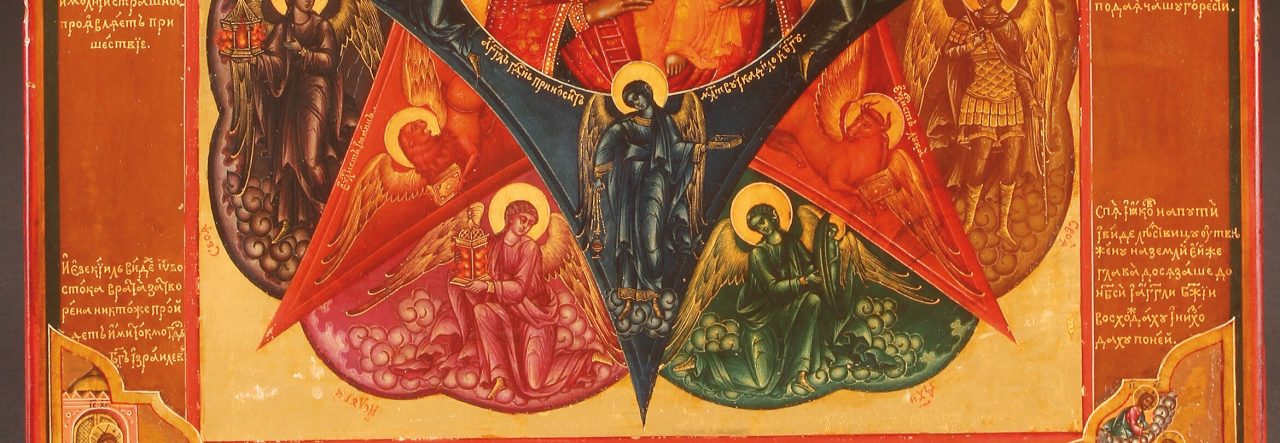
If you are a long-time reader here, you will likely recall earlier postings on “Week” icons. If you need a refresher, here is a link to one, with more in the archives. Just type “week” in the search box at right to find them all, should you wish to spend the time:
As I have discussed this type rather thoroughly in those earlier postings, I won’t repeat the identification of the various scenes today, but will merely show you today’s example. It too is an elaborate “Week” icon, but it has a secret. Here is the image:

Now if we look very closely at the lower left side, just under the feet of the row of saints, we will find a small inscription:

It says,
“Painted by the Izograph [icon painter] Zosima Iukin in the village of Palekh, Vladimir Gubernia, year 1895″
Perhaps you know already that Palekh was a famous icon-painting center, the most important of the Palekh / Mstera / Kholui trinity of Russian icon painting villages before the Revolution. Palekh icons are generally highly desirable among collectors and museums.
Well, that little inscription tells us everything we need to know, doesn’t it? The painter, the place of painting, and the date — but actually, no. It is more likely that this icon was painted around a hundred years later than that 1895 date, in the late 20th century. That is its secret.
There are things about the icon that should have raised our suspicions, two being its craquelure and the technique of painting.
Craquelure, you may remember, is the fine network of lines caused by the cracking of the paint surface over time. It is a common characteristic of old paintings. If we look at the surface of this icon, we see that the craquelure lines are oddly regular, with rather straight and long horizontal lines that set off a mass of rectangular islands of paint. Such regular craquelure is often the result of artificial aging, frequently done by bending a painted canvas at an angle across a straight or slightly rounded surface to deliberately crack the paint. Then the “aged” canvas is glued down on an old (or new) wood panel. Placing the image on an old, re-used panel makes the appearance of age seem more convincing.

As for the painting technique, if we look closely at the faces in the icon, we can see that they are painted in a rather blobby manner:

Now there actually was a Palekh icon painter named Zosima Iukin, who worked in the latter part of the 19th century, and it is helpful to compare his work with the later image. Here is a John the Forerunner as “Angel of the Desert” from Iukin’s studio:

We get a better idea of the differences if we compare two similar scenes, the first from the Iukin icon, and the second from the more recent “would-be” Iukin image.


That makes the “blobby” technique used in painting the more recent and imitation Iukin icon even more obvious.
So, the moral of this story is that one cannot always trust enticing painter-identifying information and dates on Russian icons. One must look at other characteristics of the icon itself before jumping to any hasty conclusion.
The large (17 x 20.25 inches) imitation Iukin icon shown on this page is from an upcoming auction, and the auction house has very honestly identified it by giving not only the name, date, and place of painting written on the icon, but also by actually dating the icon to “C[irca] the last quarter of the 20th century.” Knowing that, a would-be purchaser could buy it for what it is — a rather complex and interesting example of a “Week” icon, but not a genuinely old one.
 ICONS AND THEIR INTERPRETATION