Here is an icon inscribed in Greek. It represents an uncommon type, likely because the Gospel text from which it is derived is rather odd and therefore tends to be overlooked. The story is in Luke 4:29-30:
29 And they rose up, and thrust him out of the city, and led him unto the brow of the hill where their city was built, that they might throw him down the precipice. 30 And he passed through the midst of them, and went his way.
Of course the odd part is “And he passed through the midst of them, and went his way,” giving no explanation of how Jesus managed to escape getting thrown off the precipice. On reading this account repeatedly, one has the distinct impression that something has been cut from the story. When we look at the known manuscript tradition, however, we find nothing obviously amiss.
Nonetheless, there seems to have been a surviving tradition, mentioned by Aphrahat, a Syrian Christian of the 3rd century, that Jesus was actually thrown off the precipice, but “showed the power of his majesty” by not being harmed. Scholars of the Syriac harmony of the Gospels (sadly, no ancient manuscript of it in Syriac has been preserved) called the Diatessaron, saw evidence that it may have originally included a similar tradition in which Jesus was thrown off the precipice, but “passed through their midst” by flying through the air down to Capernaum (https://jbtc.org/v01/Baarda1996rev.html). As Alice remarked in Alice in Wonderland, “Curiouser and curiouser.”
The inscription at the top of the icon says:
“Jesus borne by the Jews to the Precipice.”
The city in the background is intended to be Nazareth.
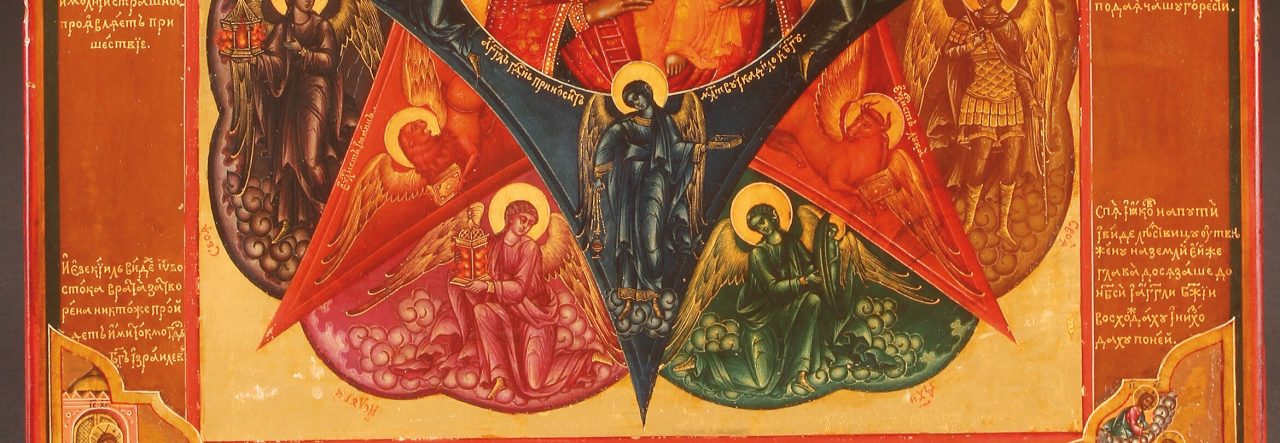
One can easily tell when looking at that posting and then looking at today’s icon, that icons of the Izhe Kheruvimi (Izhe Kheruvimui) type are variable; they do not all have precisely the same form, though generally a number of common elements are included.
The title, of course, comes from the “Cherubic Hymn,” a standard part of the regular Russian Orthodox liturgy:
Иже херувимы тайно образующе, и Животворящей Троицѣ трисвятую пѣснь припѣвающе, Всякое нынѣ житейское отложимъ попеченіе. Яко да Царя всѣхъ подъимемъ, ангельскими невидимо дориносима чинми. Аллилуіа
“[We] who cherubim mystically represent And to the Life-bearing Trinity the “Thrice Holy” hymn sing, All cares of life let us now put aside So we may receive the Tsar of all, By invisible ranks of angels escorted. Alleluia.”
By now, if you are a long-time reader here, you will likely recognize the painting style as that of the “priested” Old Believers — particularly those in the community of Vyetka. Keep in mind that usually, the larger the number of figures painted on an icon, the higher the selling price was.
The Cathedral at Monreale in Sicily has an interesting mosaic made in the Byzantine manner sometime between the 12th and 13th centuries.
The Latin inscription tells us what is on the left side: HIC PETRUS ET PAULUS IN ROMA ANTE NERONEM DISPUTAVERUNT CUM SYMONE MAGO “HERE PETER AND PAUL IN ROME BEFORE NERO DISPUTED WITH SIMON MAGUS.”
At left are Paul and Peter, and between them and Nero is Simon Magus.
All that is told of Simon Magus in the New Testament is found in the book of Acts, where Simon is said to have practiced sorcery and influenced many people in Samaria. Simon was converted to Christianity by the preaching of the apostle Philip. Then Peter and John came to Samaria, and began to give people the Holy Spirit by laying hands on them. When Simon Magus saw this, he offered the two apostles money if they would give him the ability to transmit the Holy Spirit by the laying on of hands. The Apostles told him scornfully that the gift could not be purchased with money, and advised Simon to repent of his request. Simon then says, “Pray to the Lord for me, that none of these things you have spoken come upon me” — apparently repenting.
That means, of course, that the Monreale mosaic depicts an event not told of in the New Testament. So where did it come from?
As depicted in the mosaic, the tale used appears to be that found in The Acts of Peter and Paul, a tale written in the 5th century — so not biblical at all in the customary sense. But people in early times were very heavily influenced by fictional religious works not included in the Bible.
According to the Acts of Peter and Paul, both apostles appeared before Nero, arguing with Simon Magus:
“And on the following day Simon the Magian, and Peter and Paul the apostles of Christ, having come in to Nero, Simon said: These are the disciples of the Nazarene, and it is not at all well that they should be of the people of the Jews. Nero said: What is a Nazarene? Simon said: There is a city of Judah which has always been opposed to us, called Nazareth, and to it the teacher of these men belonged. Nero said: God commands us to love every man; why, then, do you persecute them? Simon said: This is a race of men who have turned aside all Judea from believing in me. Nero said to Peter: Why are you thus unbelieving, according to your race? Then Peter said to Simon: You have been able to impose upon all, but upon me never; and those who have been deceived, God has through me recalled from their error. And since you have learned by experience that you can not get the better of me, I wonder with what face you boast yourself before the emperor, and suppose that through your magic art you shall overcome the disciples of Christ. Nero said: Who is Christ? Peter said: He is what this Simon the Magician affirms himself to be; but this is a most wicked man, and his works are of the devil. But if you wish to know, O good emperor, the things that have been done in Judæa about Christ, take the writings of Pontius Pilate sent to Claudius, and thus you will know all. And Nero ordered them to be brought, and to be read in their presence ….”
On the right side is another scene derived from the Acts of Peter and Paul. The Latin inscription describes what is shown:
HIC PRECEPTO PETRI & ORATIONE PAULI SYMON MAGUS CECIDIT IN TERRAM.
“HERE AT THE COMMAND OF PETER AND PRAYER OF PAUL, SIMON MAGUS FELL TO THE EARTH.”
It is the account of Simon Magus flying:
“Then Simon went up upon the tower in the face of all, and, crowned with laurels, he stretched forth his hands, and began to fly. And when Nero saw him flying, he said to Peter: This Simon is true; but you and Paul are deceivers. To whom Peter said: Immediately shall you know that we are true disciples of Christ; but that he is not Christ, but a magician, and a malefactor. Nero said: Do you still persist? Behold, you see him going up into heaven. Then Peter, looking steadfastly upon Paul, said: Paul, look up and see. And Paul, having looked up, full of tears, and seeing Simon flying, said: Peter, why are you idle? Finish what you have begun; for already our Lord Jesus Christ is calling us. And Nero hearing them, smiled a little, and said: These men see themselves worsted already, and are gone mad. Peter said: Now you shall know that we are not mad.
Paul said to Peter: Do at once what you do.And Peter, looking steadfastly against Simon, said: I adjure you, you angels of Satan, who are carrying him into the air, to deceive the hearts of the unbelievers, by the God that created all things, and by Jesus Christ, whom on the third day He raised from the dead, no longer from this hour to keep him up, but to let him go. And immediately, being let go, he fell into a place called Sacra Via, that is, Holy Way, and was divided into four parts, having perished by an evil fate.”
That is what we see in the mosaic. In the background is the tower framework from which Simon rose into the air, and we see him above, suddenly dropped by the (supposedly invisible) devilish angels, and falling to earth.
So there you have it. The Simon Magus who apparently repented in the book of Acts is turned into an unrepentant deceiver by the writer of this bit of early Christian “fan fiction.” It is interesting and often surprising to see the great extent to which Christian art was influenced by apocryphal and pseudepigraphical writings outside the New Testament.
A reader recently inquired about an image on the northern altar door (“Deacon’s door”) of the Annunciation Cathedral ( Благовещенский собор) in Solvychegodsk (Сольвычегодск), Russia. You may recall that Solvychegodsk was the place where the famous Stroganov family that gave its name to the Stroganov School of icon painting began mining salt in the 16th century, and thus gained great wealth and status.
Here is an image of the door, with its three different icon types:
The top image is the Vision of Paul — Paul seeing the Heavenly Jerusalem. This appears to be derived from an apocryphal text written in about the 3rd century, and known in Russia by the 14th century. It depicts “Mount Jerusalem” as a Russian church, with angels, the Deisis (Mary, Jesus, John the Forerunner) in the central circle, and at the sides various ranks of saints. Paul looks up in wonder from below left:
The bottom image on the door is the Slaying of Zakharias (Zechariah) — the priest father of John the Baptist, at the order of King Herod. A priest Zakharias is mentioned in Matthew 23:35, but the basis of this image is really the apocryphal Protoevangelion of James, not the New Testament. The early and medieval Christians were very fond of that kind of biblical “fan fiction”:
It records:
And Herod searched for John, and sent officers to Zacharias, saying: Where have you hid your son? And he, answering, said to them: I am the servant of God in holy things, and I sit constantly in the temple of the Lord: I do not know where my son is. And the officers went away, and reported all these things to Herod. And Herod was enraged, and said: His son is destined to be king over Israel. And he sent to him again, saying: Tell the truth; where is your son? For you know that your life is in my hand. And Zacharias said: I am God’s martyr, if you shed my blood; for the Lord will receive my spirit, because you shed innocent blood at the vestibule of the temple of the Lord. And Zacharias was murdered about daybreak. And the sons of Israel did not know that he had been murdered.
The icon type that concerns us today, however, is the central image, which shows the Creation of Man, the Fall, and the Expulsion from Paradise:
(Museum of History and Art, Solvychegodsk)
Let’s look more closely:
In the portion at top left, we see God making Man from earth, in his image and likeness. Note that God in this example is not represented as God the Father (Lord Sabaoth), but rather as Jesus Christ. We can see his IC XC name abbreviation written in red above his halo:
At upper right, we see Jesus again, with his IC XC name abbreviation. He is giving Adam the commandment not to eat of the fruit of the tree in the middle of the garden of Paradise, or else he will die. Adam and Eve stand facing the tree, dressed in regal finery:
At lower left we see the serpent entwined around a tree, telling Eve that if she eats of the tree, they will not die but will become like gods, knowing good and evil. Adam too eats of the tree, and Death enters the world.
At lower right, God commands an angel to drive Adam and Eve out of Paradise for their disobedience.
Note the big change in clothing on Adam and Eve. Formerly, they were shown in royal garments. Now they are clothed about the waist only with coverings made of leaves.
Finally, at far right, we see the cherubim (Russians use the plural for singular) with the flaming sword, guarding the entrance to Paradise (the area represented by the circle), and Adam and Eve seated gloomily outside and below, pondering their fate:
Now there are countless icons of the Creation of Man, the Fall, and the Expulsion from Paradise. What is particularly interesting in this one is that by showing the pre-Fall Adam and Eve clothed in regal finery, they are using an old tradition that when Adam and Eve were first placed in Paradise, they were in a more glorious state. In Western tradition, we tend to think of Adam and Eve in the Garden of Eden, walking about totally nude. But there is an Eastern Orthodox tradition — found also in Jewish tradition — that Adam was considered the first king (the Russians say Tsar) on the earth. He was placed there by God to rule in Paradise, much as many Russians before the Revolution thought the Tsar to be God’s appointed representative on earth. Adam was also considered a priest, because Paradise was thought, in a sense, to be the Holy of Holies, where Adam communed directly with God. So that is why, in this icon, Adam and Eve are clothed in royal finery, which they lost when they ate the forbidden fruit and were cast out of Paradise. Note that such a depiction is very uncommon in icons.
If you would like to see more icons in the Annunciation Cathedral at Solvychegodsk, you will find a number of photos on this Russian site: https://www.isilgan.ru/2013/09/blog-post.html


 ICONS AND THEIR INTERPRETATION