A CLOUDY ANGEL

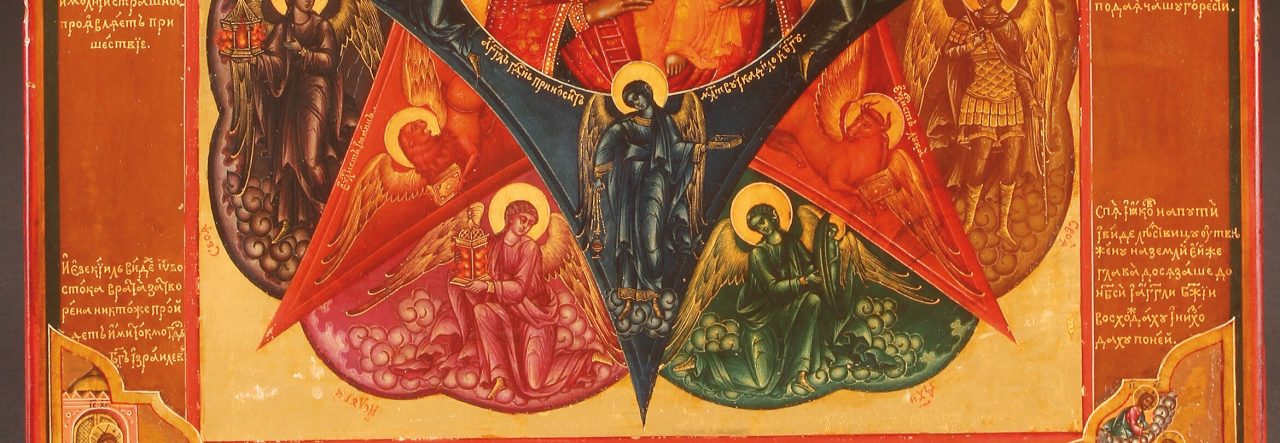
Here is a fresco from the Dionysiou Monastery on Mount Athos.  The subject looks quite bizarre.  It is a rather literal visual interpretation of an event in chapter 10 of the Apocalypse:


The inscription at right is an excerpt from that chapter:

Καὶ εἶδον [ἄλλον] ἄγγελον ἰσχυρὸν καταβαίνοντα ἐκ τοῦ οὐρανοῦ, περιβεβλημένον νεφέλην, καὶ ἡ ἶρις ἐπὶ τὴν κεφαλὴν αὐτοῦ, καὶ τὸ πρόσωπον αὐτοῦ ὡς ὁ ἥλιος, καὶ οἱ πόδες αὐτοῦ ὡς στῦλοι πυρός

And I saw [another] mighty angel come down from heaven, clothed with a cloud: and a rainbow was upon his head, and his face was as it were the sun, and his feet as pillars of fire.

We see John the Theologian (Apostle John/Evangelist John) at left, holding a book on which we can read words  from Revelation 10:8 and 10:9 combined:

Λάβε τὸ βιβλίονκαὶ κατάφαγε αὐτό, καὶ πικρανεῖ σου τὴν κοιλίαν, ἀλλ’ ἐν τῷ στόματί [σου ἔσται γλυκὺ ὡς μέλι.]

Take the book … and eat it; it shall make your belly bitter, but in your mouth [it shall be sweet as honey]. 

Biblical scholarship notes that there is a great gap between the style of the Greek in the gospel attributed to John and that of the Apocalypse, so whoever wrote the first (it was originally anonymous) cannot possibly also have authored the second.  Of course all this was quite unknown to the painters of icons.

It is interesting to compare the Dionysiou fresco with the woodcut from Albrecht Dürer’s Apocalypse series. 


FIRST NOT, THEN HOT

We have seen in previous postings how Eastern Orthodoxy and the Catholic and Protestant Churches in Western Europe took quite different paths in the painting of icons and religious images.  One of the most striking examples is found in the treatment of Saint Sebastian, who by tradition was martyred in Rome near the end of the 3rd century under Diocletian and Maximian.   His highly dubious hagiography has him being educated in Milan and though Christian, becoming a captain in the Praetorian Guard.  His “life” was apparently written in the 5th century.

Here is a fresco of the martyrdom of Sebastian by Tsortzis Phouka, painted about 1547 in the Dionysiou Monastery on Mount Athos, Greece:


The inscription reads:

Ὁ ἉΓΙΟC CΕΒΑCΤΙΑΝΟC ΤΟΞΕΥΟΜΕΝΟC ΤΕΛΕΙΟΥΤΑΙ
HO HAGIOS SEBASTIANOS TOXEUOMENOS TELEIOUTAI

It means loosely,
“Holy Sebastian Ends by Being Shot with Arrows.”

It was not literally his “end,” however, according to his hagiography;  he supposedly survived all the arrows, only to be later clubbed to death.

In Eastern Orthodoxy, Sebastian is generally depicted as a middle-aged man with a beard.  And as is often seen in depictions of males in icons, his hips are excessively large in proportion to the rest of his body.

Now Western European art took quite a different course with St. Sebastian from the time of the Renaissance.  There he was commonly depicted as beardless and young and well-formed, in what is generally considered to be a homoerotic manner.  To put it bluntly, in spite of the arrows used to identify his image, Sebastian became a sex object.  He is often depicted in calm repose, a tranquil look on his face, as though the arrows piercing him were merely a trivial inconvenience.  Here is an example by Antonello da Massina, painted near the end of the 1470s — the early Italian Renaissance:

(Antonello da Messina, c. 1477-79; Gemäldegallerie, Dresden)

And here is another example, by the famous Sandro Botticelli:

(Gemäldegalerie, Berlin)

That Renaissance tradition of depicting Sebastian as a young and attractive male has continued to the present.  Here is a painting from 1925, by the Swedish artist Owe Zerge:

(Garpenhus Auktioner)

One could hardly find a more striking example of the contrast between the dry stylization of old and traditional Greek and Russian iconography and the realism of Renaissance and post-Renaissance Western European religious art.

PLAYING BY EAR

Today we will look again at the Blagovyeshchenie — the Annunciation.  Here is a pleasant example which, if you are clever, you will recognize as part of the new movement in Russian icon painting that began in the later half of the 1600s.  It involved a gradual tendency — borrowed from the Catholic West — toward greater realism and away from the strong stylization of earlier Russian icons — a stylization that was continued in the Old Believer tradition even as the State Church tradition departed from it.

So we know this is a State Church icon.  It was painted in 1670 by Ivan Maksimov.  If you detect the influence of Simon Ushakov here, you are correct: Maksimov was a student of Ushakov.

We see the usual elements:  the Archangel Gabriel at left, Mary at right, with her book open before her.  It is worth noting that in early icons of the subject, Mary was shown with her distaff and “purple” (usually red in images) thread.  But beginning in Western European art of the 9th century, and becoming very widespread in the 11th, she began being depicted instead with a book.  So this is another element borrowed from the West.

What I want to discuss today, however, is what is happening in the upper half of the icon:


We see the crowned Lord Sabaoth in the clouds at upper left, and a ray of light extending from him downward to the head of Mary; and in that ray the Holy Spirit descends in the form of a dove to impregnate Mary with Jesus.

Well, if he is impregnating her, why does the ray of light extend to her head rather than her womb?

Theologians had a great deal of trouble with the conception and birth of Jesus.  A god impregnating a human woman was nothing new.  We find it in the Greek and Roman stories of the gods and heroes.  But Christians had a real distaste for sex and for the messiness of birth, and they tried to adjust their notions of the conception of the birth of Jesus accordingly.  One school of thought arose that held Mary conceived Jesus not through the usual area of the female body, but rather through her ear.

Now to arrive at this conclusion involved a considerable amount of theological tap dancing.  It was believed that Jesus was the “Word” of God, the divine Logos.  A word is heard through the ear.  And because Eve, the first woman, was deceived into the Fall by receiving the words of the serpent in Eden through her ear, even so it was felt to be fitting that Mary should receive the cure for the Fall — the incarnation of Jesus, who is the Word — through her ear.  And so a widespread belief arose — often reflected in iconography — that Mary conceived Jesus through her ear.

In the 4th century, we find this in the writing of Athanasius of Alexandria:

Come and gaze upon this marvellous feat: the woman conceives through the hearing of her ears!

And Ephrem the Syrian (307-373) wrote:

Like the Burning Bush on Horeb, which carried God in the heart of the flames, so Mary brought Christ into her virginity; through her ear the Word of the divine Father entered and dwelt sec­retly in her womb.”

Perhaps you noticed that instead of a white lily, Gabriel in this icon is carrying a bouquet of roses and what appear to be a rather fanciful variation on tulips.  And through the window in the background, we can see part of a vase holding another bouquet: