ѠБРАЗ СВЯТАГО НИКОЛЫ ЧУДОТВОРЦА OBRAZ SVYATAGO NIKOLUI CHUDOTVORTSA
“IMAGE OF HOLY NICHOLAS THE WONDERWORKER.”
Nicholas holds a sword in one hand and a church in the other. When he is depicted in this way, he is called “Nicholas of Mozhaisk.” The title of the type originated in the belief that Nicholas was the miraculous defender of the city of Mozhaisk from the invading Tartars. The church in his hand is sometimes shown as a miniature city.
To the left of Nicholas, we see Jesus in the clouds, and to the right, Mary.
Let’s take a closer look at the face of Nicholas:
Nicholas is flanked by saints on both sides. Here are those at left:
From top:
“Holy Martyr Tatiana”
“Holy Equal-to-the-Apostles Mary Magdalene”
“Holy Alexei, Metropolitan”
Here are those at right:
“Holy Great Martyr Anastasia”
“Holy Alexandra, Empress”
“Holy Olga, Princess”
The painter certainly had a definite way of painting faces — so much so that these saints all look very similar in facial features.
The icon is heavily gold leafed, and that enabled the painter to incise baroque ornamentation in the corners of the image and floral ornaments on the garments, such as we see on the robe of Nicholas:
Well, that covers most everything on the icon. But if we left it at that, we would miss the most significant thing about the image. Let’s look again at the names of the saints depicted:
Nicholas
Alexandra
Olga
Tatiana
Maria
Anastasia
Alexei
Now if you know anything at all about Russian history, those should sound very familiar — because they are the names of the last Russian Tsar and his family. And that is the most significant thing about this icon; it represents the saints for whom the members of the ill-fated last Russian Imperial Family were named.
The icon was painted in what was then the Province of Chernigov, and is now the town of Shelomy in Bryansk Oblast, Russia.
If we look at this old map, there are three red dots from the top to the “Tschernigow” (Chernigov) name in large letters. The third red dot down from the top is the Old Believer settlement of Starodub. Go straight West from Starodub, and the first village you come to is “Schelomy” — Shelomy. And if we continue West from Shelomy and cross the red border, we come to Wjetka — “Vetka.” These were all Old Believer settlements.
An inscription on the reverse says the icon was painted by an Old Believer for presentation on the “Angel Day” — the name-saint day — of Tsar Nicholas, in 1906.
Now there is something odd about that, and it is that an Old Believer is not likely to have had any interest in painting anything for or having to do with the Tsar of Russia, whom Old Believers in general considered a heretic. But it is very like that this particular Old Believer was one of the Eдиноверцы/Edinovertsui — that is, one of the Uniates. The Uniates were a religious category that began in the latter part of the 18th century — an attempt by the State Russian Orthodox Church to make some accommodation that would allow Old Believers to have a certain unity with the State Church while still keeping their practice of using the old rituals. Many Old Believers would have nothing to do with the arrangement, but some communities did make the transition. The project seems to have really begun as an attempt to bring the Old Believers back into the State Church, but even though some accepted the Edinovertsui/Uniate designation, the attempt to make them fully “State Church” was a failure. They preferred to keep their own ways.
In the previous posting I discussed a multiple icon — one of those with four separate icon images on a single panel. And on such icons we often — but not always — find a central image as well.
(Courtesy of Maryhill Museum)
As you see, that is the case with today’s icon. You will recall (hey, it was only yesterday!) that on the previous icon, the central image was the Crucifixion. Well, on today’s image it is a circle containing the so-called “Image Not Made by Hands” — also known as the Mandylion.
If you have been a diligent student of my past postings, you will be able to easily read every inscription in the circle.
But just in case, I will translate the top and bottom inscriptions:
Top:
Literally, it means the Life- (Zhivo-) bearing (nosnui) Spring (Istochnik), but we can just call it the “Life-giving Spring.” or “Life-giving Fountain.” You will find a discussion of the type here:
To that we need only add the name inscriptions of the two angels. That at left is
СВЯТЫЙ МИХАИЛЪ АРХАНГЕЛ/Svyatuiy Mikhail Arkhangel/”Holy Michael, Archangel — and that at right is СВЯТЫЙ ГАВРИИЛЪ АРХАНГЕЛ/Svyatuiy Gavriil Arkhangel/”Holy Gabriel, Archangel.”
Now on to the second icon type. Here it is with its title inscription:
It reads:
НЕЧАЕННЫЯ РАДОСТИ ПРЕСВЯТЫЯ БОГОРОДИЦЫ NECHAENNUIYA RADOSTI PRESVYATUIYA BOGORODITSUI
“UNEXPECTED JOY MOST-HOLY GOD-BIRTHGIVER
In normal English, the “‘Unexpected Joy’ Most Holy Mother of God.”
The title is often found as Нечаянная Радость/Nechayannaya Radost’/”Unexpected Joy.”
I discussed the “Unexpected Joy type previously in some detail here:
To that explanation, I should add here a mention of the words extending from Mary to the kneeling man, and from him to Mary — their conversation:
As you can see, the line bearing Mary’s words is upside-down, to distinguish it from the man’s initial question, which is right-side-up.
He says to Mary,
О Госпоже, кто сие сотвори/O Gospozhe, kto sie [siya] sotvori/ “O Lady, who did this?”
Mary responds:
ты и протчия [прочии] грешники грехами сына / Tui i protchiya [prochii] greshniki grekhami suina / “You and other sinners with sins my son …”
Mary’s response is cut short in this example. What she replies in full is generally, “You and other sinners with [your] sins have crucified my son, like the Jews.” It is only the first part of a longer conversation. So in this tale we find again the anti-Semitic motif that the “Jews” crucified Jesus — the notion that caused so much suffering and persecution of Jewish people over the centuries.
The tale of the “Unexpected Joy” icon is found in the literary work Руно орошенное/Runo oroshennoe/”Dew-wet Fleece, written by the hagiographer and saint Dimitriy Rostovskiy (1651-1709). Customarily, icons of the “Unexpected Joy contain the text box seen in this example:
“A CERTAIN LAWLESS MAN HAD A DAILY RULE TO PRAY TO THE MOST HOLY MOTHER OF GOD WITH THE WORDS OF THE ARCHANGEL’S GREETING.”
The “words of the Archangel’s greeting” are the words of the Archangel Gabriel to Mary at the Annunciation: Радуйся, Благодатная! Господь с Тобою … / Raduysya, Blagodatnaya! Gospod’ s Toboiu … / Rejoice, Blessed One! The Lord is With You …” Or as it is commonly rendered in English, “Hail Mary, full of grace! The Lord is with you …” etc.
Expect some variation in spelling and length of text from example to example.
The fourth icon image is at lower left:
As the small title inscription above Mary’s shoulder says, it is the
And now the last icon type on this multiple icon, at lower right:
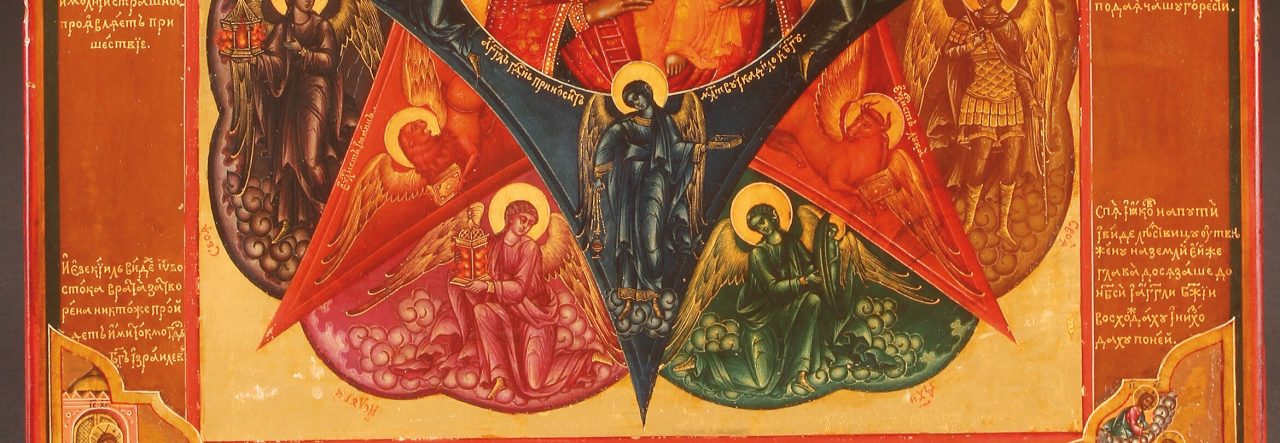
Yes, it is that red-faced icon type of Mary so popular among the Old Believers, who considered fire a purifying force, and Mary — who bore Jesus in her womb — as filled with the fire of divinity.
As the title inscription above Mary’s shoulder at right says, this is the
ѠГНЕВИДНЫЯ ПРЕСВЯТЫЯ БОГОРОДИЦЫ OGNEVIDNUIYA PRESVYATUIYA BOGORODITSUI
“‘FIRE-APPEARING’ MOST HOLY MOTHER OF GOD”
You will find the Ognevidnaya icon type discussed in this previous posting:
We should take a closer look at the rendering of the halo, because this painter ornamented that of Mary with painted jewels and pearls:
And here is a closer look at the face of the image:
We cannot finish today without identifying the border saints, which as I hope you recall, are commonly the saints for whom the members of the family ordering the icon are named.
Here are the first three at left:
From the top, they are;
Prepodobnuiy Feodor/Venerable Theodore Svyatuiy Apostol” Petr”/Holy Apostle Peter (he carries a scroll with the “You are [Peter”] text, an the keys to the Kingdom of Heaven)
Svyatuiy Apostol’ i Evangelist Ioann Bogoslov/Holy Apostle and Evangelist John the Theologian
Here is the final saint at left:
He is Svyatuiy Mikhail” Arkhangel”/Holy Michael, Archangel — and he is in armor as leader of the heavenly armies, and carries a flaming sword and a trident-like lance.
Here are the first three saints in the right border:
They are:
Predpodobnaya Mariya Egipetska[ya]/Venerable Mary of Egypt
Prepodobnaya Evdokiya/Venerable Eudocia
Prepodobnaya Paraskovi[ya]/Venerable Parasceva
And the final saint and end of this posting’s discussion is:
Today we will look at another four-part icon. Such multiple icons (иконы многочастные/ikonui mnogochastnuie) enabled the purchaser to have four or five different icon images on a single panel — the equivalent of that many separate icons. You will also find them referred to as “four-field” icons and “quadripartite” icons. I like the term “multiple” icon, which covers anything from two to three to four to five or more individual icon images painted on a single panel.
This is a Vetka / Ветка icon, as are certain others in the Maryhill Museum collection. By that I mean it is in the manner typical of the Old Believer settlements in the region of the towns of Vetka (now in Belarus) and Starodub (now in nearby Briansk Oblast, Russia). This area has changed hands often over the centuries, but it is where today the borders of Belarus, Russia, and Ukraine come together.
(Courtesy of Maryhill Museum)
We will begin with the first image at upper left:
I hope you all easily recognize it as an example of the “Joy to All Who Suffer” type, which I discussed in previous postings. You have probably noticed that there are always variations as to which saints are included, as well as whether the “suffering” are picture too, or — as here — omitted.
Venerable Pelagia
Venerable Paisiy/Paisius
Righteous Aleksiy/Alexei, Man of God
Holy Prophet Iov/Job
Venerable Iosif/Joseph
The second image is at upper right, with its title inscription:
It reads:
СТРАДАНИЯ СВЯТЫХЪ МУЧЕНИКОВ КИРИКА И ОУЛИТЫ STRADANIYA SVYATUIX” MUCHENIKOV KIRIKA I OULITUI
“THE PASSION OF HOLY MARTYRS KIRIK/CYRICUS AND OULITA/JULITTA” Stradaniya — meaning “suffering” or “passion” is a term often used in icons for the suffering during martyrdom of various saints.
Here is the icon:
Kirik and Oulita were supposedly a mother-son pair of martyrs under Emperor Diocletian. Their hagiography says they were arrested at Tarsus in Cilicia. The ruler there attempted to ingratiate himself with the boy, but three-year-old Kirik was having none of it, and the tale says that he called on the name of Christ, and kicked the ruler in the stomach. At this offense, the ruler threw Kirik down the steps with such force that his head was crushed. His mother Oulita was tortured, then beheaded in the year 296 c.e.
The sequence of scenes in the icon begins at lower left with the “Birth of Holy Martyr Kirik”:
It continues at lower right, with Kirik and Oulita brought before the ruler:
Then the scene moves to upper left:
The inscription tells us that the hegemon/ruler had Oulita beaten, and Kirk cried out “I am a Christian,” and pulled the beard of the ruler, who then killed him.
At upper left, the inscription tells us, we see Oulita praying at the time of her martyrdom, then after her prayer she was beheaded:
The third icon type of the four-part icon is at lower left. It is identified by its title inscription:
ВЗЫСКАНИЕ ПОГИБШИХЪ ДУШАХЪ
VSUISKANIE POGIBSHIKH” DUSHAKH”
“RECOVERY OF LOST SOULS.”
This icon type — which was quite popular in the 19th century — is more commonly known in English by the more loosely translated title “Seeker of the Lost.”
Here is the image:
The fourth icon is at lower right. It is a gathering of saints, and the saints included would usually depend on the choice of the purchaser of the icon.
Well, given that it is a four-part icon, we should be done with it, right? Wrong. Four-part icons often have a central image, which — as here — is frequently the Crucifixion:
It has some of the usual inscriptions, which I have discussed in previous postings. “Jesus of Nazareth, King of the Jews” is abbreviated on the top crosspiece. On the larger crossbeam is “King of Glory” and “Son of God.” There is an additional four-letter abbreviation that appears to be a miswriting of НИКА –NIKA — the standard Greek inscription meaning “He Conquers.” We see also the abbreviations for “spear” and “sponge” above the implements of the passion.
On the lower slanting crosspiece we see “The Place of Judgment Has Become Paradise,” and the two-letter abbreviation for “Hill of Golgotha.” And we see the blood of Jesus dripping down onto the “Skull/Head of Adam.”
Now there are all kinds of variations as to which icon types are included in four-part icons. That again depended on the choice of the person ordering the icon.
Oh yes — and before we finish with this icon, we must also note the presence of “Lord Sabaoth” — God the Father — in the clouds at top center of the four-part icon. And in the circle just below him is the Holy Spirit in the form of a dove.
In previous postings I have talked about the metal covers often found on icons. Such a cover is called a riza (“robe”) in traditional terminology, though since the Soviet period the word oklad is often used. I have also talked briefly about embroidered covers, which are considerably more delicate. Some covers were heavily ornamented with beadwork, fake pearls and fake “jewels,” such as this example of the “Kazan” Marian image type:
(Courtesy of Jacksonsauction.com)
Today we will look at still another form of ornamental covering for icons, made primarily for those kept in the wooden case called a kiot, because this kind of cover is easily damaged. It is made of cut and embossed metal foil (фольга/фольга), often combined with fabric and beadwork. Making foil covers and ornamentation for icons was a kind of popular 19th and early 20th century folk art in Russia and Ukraine, and it is still practiced today. Embossing such thin metal foil was very easily done, though it took care and time.
Here is a look at some icons with ornamental foil.
First is an example of Gospod’ Vsederzhitel — “The Lord Almighty.” As you can see, it is a mixture of cut and embossed foil, artificial flowers, and even fabric and beads. It has a very Victorian look to it, with the kind of gaudy ornamentation so common in that period and later in the 1800s:
(Courtesy of Jacksonsauction.com)
Here is an example of the Pribavlenie Uma type — the “Growth of Reason.” an icon popular with students:
(Courtesy of Jacksonsauction.com)
It is again a mixture of cut and embossed foil, fabric, and various kinds of beads.
Finally, here is an example of foil work on an unusual image — a depiction of the chapel in the “Holy Sepulchre” in Jerusalem. Now as you might expect, given the inexpensive and popular nature of such foil-ornamented icons, the images themselves were often prints rather than painted icons:
(Courtesy of Jacksonsauction.com)
If we look more closely, we can see the title label identifying the image:
It reads:
БЛАГОСЛОВЕНИЕ ОТЪ ЖИВОНОСНАГО ГРОБА ГОСПОДНЯ BLAGOSLOVENIE OT” ZHIVONOSNAGO GROBA GOSPODNYA
“A BLESSING FROM THE LIVE-GIVING GRAVE OF THE LORD.”
So we know that this image was probably brought from Jerusalem by a Russian pilgrim as a religious souvenir, and then was ornamented with foil in Russia when it was placed in a protective frame.
Here is a video — all Russian with no translation — but it gives a close-up look at foil work on an icon image, and helps to better understand the nature of such ornamentation:
Today’s example is very useful in learning to read inscriptions, so I will dwell on those in some detail, in order to help those of you who are just beginning to learn to translate Church Slavic inscriptions.
First we should look at the title inscription at the top: It begins at left, and continues at right:
ѠБРАЗ ВСЕМ СКОРБЯЩИМЪ OBRAZ VSEM SKORBYASHCHIM”
IMAGE [of] TO-ALL SUFFERING
РАДОСТЬ ПРЕСВЯТЫЯ БОГОРОДИЦЫ RADOST’ PRESVYATUIYA BOGORODITSUI
JOY MOST-HOLY GOD-BIRTHGIVER
If we put it all together we get:
ѠБРАЗ ВСЕМ СКОРБЯЩИМЪ РАДОСТЬ ПРЕСВЯТЫЯ БОГОРОДИЦЫ OBRAZ VSEM SKORBYASHCHIM” RADOST’ PRESVYATUIYA BOGORODITSUI
“IMAGE OF THE JOY TO ALL WHO SUFFER MOST HOLY MOTHER OF GOD”
Now as you can see, the final translation has been put into normal English. This type is also often called in English the “Joy of All Who Suffer” Mother of God.
Here is the icon:
(Courtesy of the Maryhill Museum of Art)
At top center we see ГОСПОДЬ САВАѠФЪ/GOSPOD’ SAVAOF” — “LORD SABAOTH” — God the Father. He blesses with his right hand and holds a cross-topped orb — the symbol of universal rule and authority — in has left:
Now the position of the fingers in his blessing hand tells us that this is an Old Believer icon, which is not surprising, given its stylized form.
Below and to the left of Lord Sabaoth, we see this:
It is of course the sun, and we see the Church Slavic word СОЛНЦЕ/SOLNTSE — “SUN” just above it.
On the right of the icon is the moon — ЛУНА/LUNA — among the stars.
It is common in Russian iconography for the sun and moon to be given faces — anthropomorphized. You may recall that the other icon type in which the sun and moon are commonly found is the Crucifixion, but in that type the sun is darkened and the moon is blood red, in contrast to this type, in which the sun and moon are represented normally.
If you are a long-time reader here, you will recognize the central image of Mary and the child Jesus as a version of what is called in German the Strahlende Madonna — the “Radiant Madonna.” And you may recall that in some versions of this icon type, Mary is shown without the child Jesus on her arm: Here both are crowned, and Mary has a string of painted jewels in her halo:
The abbreviation above her is the standard Greek ΜΡ ΘΥ, identifying her as Μήτηρ Θεού / Meter Theou — “Mother of God.” While all other inscriptions on Russian icons are generally in Church Slavic, Russian iconography nonetheless kept this abbreviation as the identifying mark of Mary. And as you can see, it also kept the standard Greek abbreviation used to identify Jesus in Russian icons: IC XC for Ιησούς Χριστός / Iesous Khristos — “Jesus Christ.” Each abbreviation has the curved horizontal line indicating abbreviation above it.
If we look at Jesus in the arms of Mary, we can see that his halo contains the usual inscription used for him in the cross outline visible behind his head.
The Greek form of the halo inscription is Ὁ ѠN — HO ON — meaning “The One Who Is” — a title of God found in Exodus 3:14. The letters are read top-left-right, as they usually also are in Bulgarian icons. In Russian icons, however, the left letter is commonly changed from Ѡ to Slavic Ѿ — pronounced “ot” — which enables them to read the inscription left-top-right while giving it various fanciful interpretations. That is what we see here. Some like the letters to represent the members of the Trinity, interpreting them as abbreviations for the Three-Hypostatic Godhood, represented in the letters as Ѿ (ot) for Ѿтеческий/Otecheskiy — “Of the Father’s”; О for Оум/Oum — “Mind”; and Н for Непостижимъ Сыин/Nepostizhim Suin — “Unfathomable Son.”
Still others read it as abbreviating От небес приидох — Они же Мя не познаша — На кресте распяша Ot nebes priidokh — Oni zhe mya ne poznasha — Na kreste raspyasha
“From heaven I came — They knew me not — On the cross I was crucified.”
Now for some practice in reading saints’ names. Let’s begin with those just to left of Mary, beginning at the top:
At the very top, we see this saint wearing a monk’s garments:
ПРД ЗОСИМЪ СОЛ PRD ZOZIM” SOL
The first and last words are abbreviated. In full the title is:
ПРЕПОДОБНЫЙ ЗОСИМЪ СОЛОВЕТСКИЙ PREPODOBNUIY ZOSIM” SOLOVETSKIY
“VENERABLE ZOSIM/ZOSIMA OF SOLOVETSK”
You may recall that he is one of a pair of saints often found in icons: Zosim and Savvatiy Solovetskiy — the founding fathers of the Solovetskiy/Solovkiy Monastery and the patron saints of beekeeping. Remember that Prepodobnuiy (literally “most-like” — meaning most like Christ, or most like Adam before the Fall) is commonly translated into English as Venerable — and that this is the masculine form, the common title for a monk.
Now as you can see, the PRD here abbreviates PREPODOBNAYA — the female form of Prepodobnuiy, and it is the common title for a nun. And as we see, Feodosiya is wearing a nun’s garments. Presumably she is Theodosia of Constantinople.
Now oddly enough, the writer has given the saint at right the PRD abbreviation too — which he usually does not have, because he was not a monk. So we will omit it here. He is:
ВАСИЛИЙ БЛАЖЕННЫЙ VASILIY BLAZHENNUIY
“VASILIY THE BLESSED.”
BLAZHENNUIY is a title commonly used for “Holy Fools,” those called “Fools for Christ’s Sake.” And this Vasiliy/Basil is the same fellow for whom the St. Vasiliy/Basil Cathedral in Red Square in Moscow is named. Vasiliy was prayed to for safety from fire, for the cure of eye problems, and for help when beginning a new task in a workshop.
Next come two very familiar saints:
At left is:
СВЯТЫЙ ПАВЕЛЪ АПОСТОЛ SVYATUIY PAVEL” APOSTOL
“HOLY PAVEL/PAUL APOSTLE”
So he is the Apostle Paul, from the New Testament. He is often prayed to for protection of children from death. And beside him is
And that is St. Peter from the New Testament. Notice that he holds the keys to the Kingdom of Heaven in one hand, and also a scroll reading:
ТЫ ЕСИ ПЕТР НА СЕМ КАМЕНИ TUI ESI PETR NA SEM KAMENI
“YOU ARE PETER: ON THIS ROCK”
The words are taken from Matthew 16:18: ты еси Петр, и на сем камени созижду Церковь Мою, и врата адова не одолеют ей: Tui esi Petr, i na sem kameni sozizhdu tserkov’ moiu, i vrata adova ne odoleleiut ey
“You are Peter; on this rock I shall build my church, and the gates of Hades shall not Prevail against it.”
Peter was prayed to for relief from fevers, and Paul — like the Holy Fool Vasiliy — for help when beginning a new work in a workshop.
Then we have two saints robed as bishops, with the bishop’s stole (Slavic omofor/Greek omophorion around their necks and the Gospel book in their hands:
“Nikita” is the more common spelling, but in icons it is not unusual to find spelling variations — usually phonetic. We find here the relatively common substitution of “o” for “a.” It is a spelling change frequent in Russian icons because the unstressed “o” in Russian sounds rather like “a.”
At left below him, dressed in warrior’s garments and holding the cross of martyrdom, is:
СВЯТЫЙ ГЕОРГИЙ ВЕЛИКОМУЧЕНИК SVYATUIY GEORGIY VELIKOMUCHENIK
“HOLY GEORGE GREAT-MARTYR
He is the famous saint of “St. George and the Dragon” icons. He was often prayed to for the protection of flocks.
To the right of George is:
СВЯТАЯ АННА ПРАВЕДНАЯ SVYATAYA ANNA PRAVEDNAYA
“HOLY ANNA RIGHTEOUS”
This is the Anna who in apocryphal sources such as the Protoevangelion of James was the mother of Mary, mother of Jesus. Her title Pravednaya/Righteous (male form Pravednuiy) is often used for saints considered to be in some way “Old Testament” — and Anna and her husband Joachim were predecessors of the Gospel. Notice that Svyataya is the female form of male Svyatuiy (“Holy”). Anna was often prayed to for conceiving children.
Next comes a pair of brothers often found together in icons:
The title Bezsrebrenik means literally “without (bez-) silver (-srebre/серебро) guy (-nik). It is generally used for physicans who treated patients without asking payment. Note that as we saw in the name “Nikito,” in Russian icons the letters o and a are often interchanged in the spelling of Domean/Damian. The two were prayed to for educational matters and of course for healing.
The last two saints on the main part of the icon are both dressed as bishops, with omophorion and Gospel book:
At left is one of the most frequently found saints in Russian iconography, after Mary and Jesus. he is:
Nicholas the Wonderworker is Nicholas of Myra, who later morphed into the American Santa Claus. His name is generally found as Nikola or Nikolai — and in regions such as Belarus as Mikola. He was often prayed to for safety on the water and protection from drowning.
Last, to his right, is:
СВЯТЫЙ ИОАННЪ ЗЛАТОУСТ SVYATUIY IOANN” ZLATOUST
“HOLY JOHN CHRYSOSTOM”
His name in Slavic means literally “Golden (zlat-) Mouth (-oust).” He is one of the “Three Hierarchs” often found together in Russian icons. He was an archbishop of Constantinople and a noted orator, but also, unfortunately, a virulent anti-Semite. It was thought helpful to pray to John Zlatoust/Chrysostom when in despair.
You perhaps noticed that the titles on this icon are arranged in the halos like this:
SVYATAYA ANNA PRAVEDNAYA
“HOLY ANNA RIGHTEOUS”
Ordinarily, however, they are like this:
SVYATAYA PRAVEDNAYA ANNA
“HOLY RIGHTEOUS ANNA”
Of course the outcome is the same, but the second form is that generally found in icons.
Though we will not look at them individually, in the outer left and right borders of the icon — commonly the location of saints for whom the members of the family were named, we find these:
Left, from top:
Holy Vasiliy/Basil
Venerable Makariy/Makarios
Holy Great Martyr Dimitriy/Demetrios
Venerable Feodor/Theodore
At right, from top:
Holy Great Martyr Artemiy/Artemios
Holy Martyr Anastasia
Venerable Vasiliy/Basil
Venerable Maria/Mary of Egypt
Now the inscription in the rectangle at the base:
On Marian icons, we often find an inscription with lines from a Marian hymn or a prayer to Mary. In this case it is the former.
At the beginning, we see these words in red:
ТРОПАРЬ ГЛАСЪ Д TROPAR’ GLAS” D
TROPARION VOICE 4
Note that the letter Д (D) here is used as a number.
A troparion is a brief hymn found in liturgical texts. By “voice” is meant “tone” — and by that is meant a musical mode. There are traditionally eight modes — categories of melodies — in Eastern Orthodox hymns.
So we know this text is a hymn, and by its context, most likely a Marian hymn. But which one is it?
Well, here is the text in a modern Russian font (note that the letter ъ is often omitted at the end of some words in modern form):
Тропарь, глас 4.
К Богородице прилежно ныне притецем грешнии, со смирением припадающе и покаянием, вопиюще из глубины душевныя, Владычице помози милосердовавши на ны, и потщися яко изгибаем от множества грехов. Не отврати раб Своих тощ, Тебе бо Едину Помощницу имамы.
“To the Mother of God let us sinners now earnestly run, with humility falling down in repentance, crying from the depths of the soul: O Lady, mercifully help us, and make haste, for we perish from the multitude of sins. Turn not your servant away empty, for you are our only hope.”
It is from the “Canon to the Most Holy Mother of God.”
Do not expect to always find the same text on icons of the “Joy to All Who Suffer.” The text used varies from example to example. And keep in mind that the wording on Old Believer icons often differs somewhat from that used in the “revised” State Orthodox Church liturgical books.
Perhaps you might like to hear a “State Church” setting by A. Arkhangelskiy of this Troparion:
Well, that’s it for today. Now go for a walk to work off all those cookies you have eaten while reading this.


 ICONS AND THEIR INTERPRETATION