One Marian icon type very popular in the late 18th through early 20th century was known under two different names. Sometimes it is titled Утоли Моя Печали — Utoli Moya Pechali — “Soothe My Sorrows”; other times it is named Утоли Болезни — Utoli Bolezni — “Soothe the Ills.” Nonetheless it is the same type. As an easy identifier, look for the hand of Mary held against the side of her head.
(Courtesy of Jacksonsauction.com)
Speaking of which, if you look closely, you will notice that the hand against the side of the head has its fingers in the traditional blessing sign used by and characteristic of the Old Believers. But it is not uncommon for copies of the icon painted by or for “State Church” believers to change the position of the fingers, thus removing the Old Believer sign from the image.
The painter of the example shown above was not taking any chances. He titled his rendering the Utoli Bolezni i Pechali — “Soothe the Ills and Sorrows,” combining both of the usual titles. He also reversed the image; usually Mary inclines her head to the right, and her son’s head is on the right, facing left. But this reversal is not uncommon in such types. It probably originated in a pattern being turned the wrong way.
It is customary for the scroll held by the Christ Child to bear this inscription (or at least its beginning):
Судъ праведенъ судите милость и щедроты творите кождо искреннему своему а вдовицы сира и пришельца и убога не насильствуйте, и злобы брата своего не вспоминайте.
It comes from Zachariah 7:9-10 (or 8-10 in Septuagint numeration). It begins with “Judge righteous judgment”:
8 And the word of the Lord came to Zacharias, saying,
9 Thus saith the Lord Almighty; Judge righteous judgment, and deal mercifully and compassionately every one with his brother: 10 and oppress not the widow, or the fatherless, or the stranger, or the poor; and let not one of you remember in his heart the injury of his brother.
The name of the icon is found in the troparion, tone 5, for the canon to this icon type:
Утоли болезни многовоздыхающия души моея, Утолившая всяку слезу от лица земли, Ты бо человеком болезни отгониши и грешным скорби разрушавши; Тебе бо вси стяжахом надежду и утверждение, Пресвятая Мати Дево.
It means:
“Soothe the ills of my much-sighing soul, [you who have] wiped away every tear from the face of the earth: for you drive away the sickness of men and quench the suffering of sinners. We have obtained hope and support in you, most holy virgin Mother.”
I already discussed the origin story of this icon in a previous posting, but will repeat it here:
It is said that this icon was brought from Belarus to Moscow by Cossacks in 1640, and was placed in the Church of St. Nicholas in Pupuishev. A commemoration of the icon was established after a noblewoman was said to have been healed of paralysis of the legs by the icon. According to the origin story, Mary appeared to her in a dream and told her to pray before the icon “Soothe My Sorrows,” which was to be found in the St. Nicholas Church in Moscow. The woman journeyed to Moscow and asked for the icon, but it was not discovered until the priest brought some neglected old icons down out of the bell tower, one of which bore the title “Soothe My Sorrows.” A prayer service (moleben) was held before the image, and supposedly the woman was able to walk out of the church healed. This was on January 24, 1760. A number of other supposed miracles are also attributed to this icon.
If you have been reading this site, you will notice some striking similarities between the origin story of this icon and that of the “Semistrel’naya” Marian image discussed in a previous posting. In both cases there is:
1. An afflicted person who has a dream in which a voice says to pray before an icon to be found at a certain church.
2. The icon is eventually found in the church bell tower.
One becomes accustomed to seeing the same motifs repeated again and again in the origin stories of Marian icons. This motif of the revelation in a dream of the location of a miracle-working icon — often one that has been forgotten or neglected — is common in the hagiography of Marian icons. I like to call it the “It came to me in a dream” motif.
You have probably heard of the Church of Holy Wisdom (now a museum) in Istanbul, the city which, under the name Constantinople, was once the center not only of the Byzantine Empire but also of the Eastern Orthodox Church until it fell to the invading islamic Turks in 1453. I mention it today because its name has led to some minor confusion.
That confusion arises largely from some calling the church “Saint Sophia.” However, it was not dedicated to a saint named Sophia, but rather to Jesus in his manifestation as “Holy Wisdom,” which in Greek is Hagia Sophia.
Now you will recall that Hagia in Greek means “holy,” and so it is the word used as the equivalent of our English word “saint.” So Hagia Sophia can be translated literally as “Holy Wisdom,” or it can be understood to mean “Saint Sophia.” But “Holy Wisdom” is Jesus, not a saint. There is, however, a saint found in Eastern Orthodox icons named Sophia.
Do you have all of that straight? If so, we can move on to take a brief look not at “Holy Wisdom” but rather at the saint named Sophia.
Sophia, according to tradition, was an early Roman Christian, the mother of three daughters named in Greek Πίστη/Piste, Ελπίδα/Elpida, and Αγάπη/Agape — (in Slavic Вѣра/Vyera, Надежда/Nadezha, Любы/Liubui; modern Russian Любовь/Liubov’) — “Faith, Hope, and Love” — in Latin Fides, Spes and Caritas) — all supposedly martyred during the reign of the Roman emperor Hadrian (ruled 117-138).
Here is an old Novgorodian icon of Sophia with her three daughters:
(Russian State Museum)
If we translate their names, we get a mother named “Wisdom” whose daughters are “Faith,” “Hope,” and “Love” (or “Charity,” in KJV English).
Now this may seem a bit too contrived — a mother named Wisdom, with offspring named Faith, Hope, and Love, and some scholars think precisely that — that these are completely fictional saints. Others would say that while the traditional accounts of their martyrdom are fictional, their martyrdom may have been real. In later writings there seem to have been two groups of four martyrs by the same name — one mother and daughters group with Greek names, supposedly buried on the Aurelian Way at Rome, and another group of presumably unrelated companions with Latin names, supposedly buried on the Appian Way in the Cemetery of St. Callistus.
The end of the matter is that whether they were entirely or merely partly fictional remains uncertain, but in any case their images are not uncommon in both Russian and (generally later) Greek icons.
Here they are again, in a later Russian icon that also includes the Archangel Gabriel at left and Metropolitan Mikhail of Kyiv at right:
(Courtesy of Jacksonsauction.com)
One sometimes encounters Westernized icons of the martyr Sophia kneeling beside a cross, an anchor, and a heart. These symbolize Faith (the cross), Hope (the anchor) and Love (the heart).
Now aren’t you happy to get such a short and undemanding posting after yesterday’s very long one?
This posting will be a test of just how hardcore an icon enthusiast you are (or perhaps a test of how peculiar you have really become). In any case, it is lengthy and detailed. Prepare yourself.
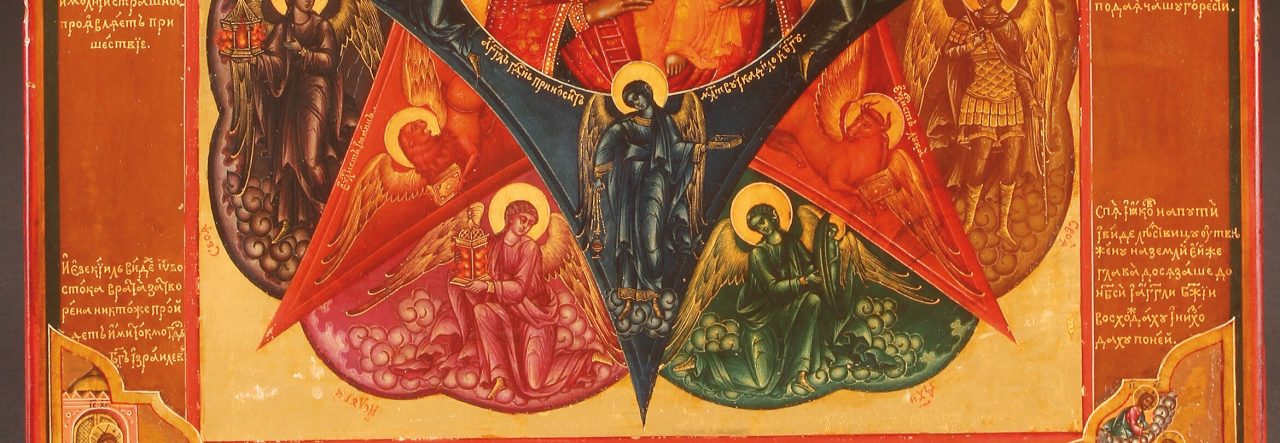
The Unburnt Thornbush (Neopalimaya Kupina) icon of Mary is of particular interest because it represents the very “pagan” notion that a painted icon of divine figures has the power to protect from fire. In old Russia, if a house or building burst into flame, people would stand holding this icon facing the fire in the belief that it would be extinguished. It was also hung to protect dwellings from fire. Given that wooden buildings and dwellings were very common, and fire a constant threat, it is not surprising that this “fire insurance” icon was so popular, particularly among the Old Believers.
There is much to say about this type. Its origins are a mixture of references to Old Testament events, to symbolic references to Mary found in the Akathist hymn and canon, and a good portion of it comes simply from apocryphal writings such as the Book of Enoch and the Book of Jubilees, particularly those portions relating to the angels surrounding the central figure of Mary holding the child Christ (Christ Emmanuel).
The Russian type, which began to spread in the late 16th century, is quite different than the standard Greek type, which depicts Mary in the Burning Bush of the Book of Exodus.
It is a detailed icon, and rather intimidating for the beginning student because of its unusual iconography and often detailed and unfamiliar inscriptions. Nonetheless, it is a visually attractive type, being in the “mandala” form that the psychoanalyst Carl Jung considered a symbol of wholeness.
In discussing the iconography of this type, one should keep in mind that there are variations from example to example, both in the figures included and in the inscriptions, though they are usually variations on the same basic concepts. Different painters might arrange figures differently and vary the inscriptions according to the models available to them and according to their own understanding. And painters sometimes did not understand their models well, or made mistakes.
The particular icon I will use as the primary example of the type is very well painted, and pleasing both in its figures and in its calligraphy. Other examples will vary somewhat, but if you understand this example, you should be able to see the essence of the type through such variations.
Let’s look at it:
(Courtesy of Jacksonsauction.com)
As you see, the icon consists of an image of Mary and the Christ Child (Christ Immanuel) set in a bright circle in the center of a blue and red eight-pointed slava (“glory”) symbolizing not only the Eighth Day of Creation (the “Day of Eternity”) but also the Godhood in its two manifestations of light and dark, that which is revealed and that which is a mystery (the “Divine Dark”). If you have mystical tendencies, you might like to view the light and red part as the cataphatic approach to spirituality through words and descriptions and concepts, and the dark blue part as the apophatic approach through negation, through getting rid of words and descriptions and concepts. Or you could just forget all of that and see it as a pretty red and a pretty blue, as did most Russian iconographers.
Mary is surrounded by angels, both in the blue quadrangle and in the outer “petals” that form an elongated simple rose-like form.
In the four corners, like the metal corners on an old bound book, are Old Testament scenes considered prefigurations of Mary.
So that is the icon in general. Now let’s get specific, beginning with the well-written calligraphic vyaz’ title inscription:
To help you out a little, I will separate the words, put them into modern Cyrillic, transliterate them, and translate them. Superscript (“written above”) letters will be in parentheses, and omitted letters will be added in brackets. The letter Ы, which some transliterate as Y, I will give more phonetically as UI. Words grammatically implied will be in lower case:
ОБРАЗ — OBRA(Z) — the “IMAGE”
НЕОПАЛИМЫЯ — NEOPALIMUIYA — of the “UNBURNT”
КУПИНЫ — KUPINUI — “THORNBUSH”
ПРЕС(ВЯ)ТЫЯ — PRESVYATUIYA — “MOST-HOLY”
Б[ОГОРО](Д)[И]ЦЫ — BOGORODITSUI — “GOD-BIRTHER”
All together, they give us OBRAZ NEOPALIMUIYA KUPINUI PRESVYATUIYA BOGORODTSUI, “the IMAGE of the UNBURNT THORNBUSH GOD-BIRTHER,
or to put it in more normal English, “The image of the Unburnt Thornbush Most Holy Mother of God.” Bogoroditsa is the Slavic term equivalent to Theotokos in Greek, meaning “one who gives birth to God.”
So now we know the title. It is the “Unburnt Thornbush” image of Mary.
Now for the iconography. We will begin at the center circle:
The large figure is obviously Mary, as indicated by the MP ΘΥ “Meter Theou” abbreviation above her, meaning “Mother of God.”
She is holding Christ Immanuel, the child Jesus, as indicated by the IC XC Iesous Khristos abbreviation above his head. He holds a rolled scroll in his left hand and blesses with his right.
On Mary’s breast is a smaller image of Jesus robed as a bishop, the “Great High Priest.” He is above a rocky hill. This image symbolizes the Heavenly Jerusalem, in which Christ is Great High Priest in the temple. The rocky hill is in some examples more obviously a stone on her breast, signifying the “Stone not cut by human hands” of Daniel 2:45:
“Forasmuch as you saw that the stone was cut out of the mountain without hands, and that it broke in pieces the iron, the brass, the clay, the silver and the gold.” This signifies the virgin birth of Jesus from Mary, supposedly born without the participation of a human male.
On Mary’s left shoulder is another crowned image, but in red; this is Jesus as “Sophia, Wisdom of God.” In that form he is shown as an angel with a red face. I should add that some people identify this figure rather loosely as Christ as Tsar Slavui, “King of Glory,” but in this example Sophia better fits the iconography.
Under Mary’s right hand is a ladder. This is one of her symbols. In the Akathist hymn are the words “Rejoice, Heavenly Ladder by which God descended.” So Mary symbolically is the “ladder” that gave birth to the heavenly Christ, his means of coming from heaven to earth.
That was not too difficult, was it? Well, as the saying goes, “You ain’t seen nothin’ yet.” It is time to look at the figures in the outer points of the eight-pointed slava.
First we will look at the four in the red quadrangle. They are the symbols of the Four Evangelists:
This figure, in the form of an angel with a book, is Еуаггелистъ Матфей — Euangelist Matfei — the Evangelist Matthew, holding his gospel.
This figure is Еуаггелистъ Марко, Euangelist Marko, the Evangelist Mark. He is depicted as an eagle holding his gospel.
This is Еуаггелистъ Лука — Euangelist Luka — the Evangelist Luke. He is depicted as an ox, and holds his gospel.
This figure is Еуаггелистъ Иоаннъ — Euangelist Ioann — the Evangelist John.
So much for the easy parts of the main image. Now we move on to less familiar figures — the angels in the blue quadrangle of the slava:
First, there is this multi-winged angel. Traditionally a seraph is painted red and a cherubim (Russians always use the plural for the singular in this case) blue, but some painters do not follow this strictly, and this figure has no inscription. But we will assume a seraph is intended, due to the fiery nature of this icon.
The inscription on these two “blue” angelic figures reads: Духъ бури Аггли Ветра — Dukh buri Angli Vyetra — “the Spirit of Storms, the Angel of Wind.”
This angel at the bottom of the blue quadrangle is identified by inscription as Аггелъ Господень Приноситъ Молитву и Кадило к Богу — Angel Gospoden Prinosit Molitvu i Kadilo k Bogu — “the Angel of the Lord — Brings Prayer and the censer to God.” Some like to think of him as the “Angel of unceasing prayer.”
The final angel in the blue quadrangle is this one:
The inscription reads: И Облаком Аггел дуги — I oblakom Angel dugi — “And of clouds, the Angel of rainbows.”
Now on to the angels in the outer “petals.” of the mandala. First, top left:
The inscription reads: Творяи Агглы своя служение снегу и инею — Tvoryai Angli svoya sluzhenie snegu i ineiu — “He makes his angels serving snow and hoar frost.” You will notice another inscription in red just above the “green” angel’s head, but we will deal with that later.
The inscription here reads Духъ силы Аггелъ росы и мглы — Dukh silui Angel rosui i mglui — “the Spirit of Power, the Angel of dew and fog.”
The inscription is: Духъ силы Аггелъ творяи мраз и ледъ благоразумно подая всем спасение — Dukh silui angel tvoryai mraz i led blagorazumno podya vsem spasenie — “the Spirit of Power, the angel making frost and ice — wisely presents to all salvation.”
The inscription is: Духъ благочестия Аггела мести нанасупостаты подая чашу горести — Dukh blagochestiya Angel mesti na supostatui podaya chashu goresti — “The Spirt of Piety, the Angel of vengeance on enemies, presenting the Cup of Woe.
The inscription: Духъ разума Аггелъ возбуждая от века спящия — Dukh razuma Angel vozbuzhdaya ot veka spyashchiya — “the Spirit of Reason, the Angel who rouses from an age of sleep.”
The inscription is: Аггелъ паления сиреч хотящаго быти от праведнаго суди и поделомъ — Angel paleniya sirech khotyashchago buiti ot pravednago sudi i podelom — The Angel of Burning, who will be sent forth by the Righteous Judge and according to [their] works.
The inscription reads: Духъ страха божия аггелъ возгремения и молни и страшное проявляетъ пришествие — Dukh strakha bozhiya angel vozgremeniya i molni i strashnoe proyavlyaet prishestvie — “the Spirit of the Fear of God, Angel of thunder and lightning, and frightfully reveals the [second] Coming”
The inscription is: Духъ премудрости аггелъ огня паляща сиреч будушее онаго века поведаетъ — Dukh premdrosti angel ognya palyasha sirech budushee onago veka povedaet — “the Spirit of Wisdom, angel of of burning fire who announces the future of the present age.”
Now we will return to the left-out word that I mentioned earlier by a top figure, in fact there are several such words arranged widely-spaced around the outer edge of the “rose.” To understand their meaning, we have to assemble them, because they belong together I have left them at the angles on which they appear, to help you place them on the image:
Tvoryai — “(He) makes…”
Angelui – (“the angels…”
Svoya — “of him…”
Dukhi — “spirits…”
I slugi — “and the servants…”
Svoya — “of him…”
Ogn — “a fire…”
Pyalyashch — “burning.”
To put it all together in normal English, “Who makes his angels spirits, his servants a burning flame.” This is the Slavic version of Hebrews 1:7: “And of the angels he says, Who makes his angels spirits, and his ministers a flame of fire.”
There are a number of apocryphal sources responsible for this notion of angels controlling the weather and the elements, but one of the most obvious is the Book of Jubilees, Chapter 2:
“And the angel of the presence spake to Moses according to the word of the Lord, saying: Write the complete history of the creation, how in six days the Lord God finished all His works and all that He created, and kept Sabbath on the seventh day and hallowed it for all ages, and appointed it as a sign for all His works.
For on the first day He created the heavens which are above and the earth and the waters and all the spirits which serve before him -the angels of the presence, and the angels of sanctification, and the angels [of the spirit of fire and the angels] of the spirit of the winds, and the angels of the spirit of the clouds, and of darkness, and of snow and of hail and of hoar frost, and the angels of the voices and of the thunder and of the lightning, and the angels of the spirits of cold and of heat, and of winter and of spring and of autumn and of summer and of all the spirits of his creatures which are in the heavens and on the earth; (He created) the abysses and the darkness, eventide (and night), and the light, dawn and day, which He hath prepared in the knowledge of his heart.
And thereupon we saw His works, and praised Him, and lauded before Him on account of all His works; for seven great works did He create on the first day.”
One can see that the components of this icon have a great deal to do with fire and burning and lightning, as well as with frost, ice, rain and clouds. When one combines these with the “fire” attributes of Mary, it is not difficult to understand how the belief arose that this icon could control the elements and subdue fire.
Now let’s look at the prefigurations of Mary in the four corners of the icon:
The inscription reads: Видехъ купину огнем горяща и незгараему рече Господь о купиныи изуи сапогъ с ногу твоему но немже ты тоиши место свято есть — “I saw a bush burning with fire and not consumed; the Lord said of the bush, take off the shoes from your feet, for this place on which you stand is holy.”
We see Моисей — Moses — kneeling to take of his shoes as he looks toward the Burning Bush in which Mary is seen in the Znamenie — “Sign” form with the child Jesus. An angel is at left of the bush. This image signifies that the Burning Bush of Moses was a prefiguration of Mary, who in her pregnancy with Jesus was filled with the fire of divinity, yet was not consumed.
The incident is recorded in Exodus 3:
1 Now Moses kept the flock of Jethro his father in law, the priest of Midian: and he led the flock to the backside of the desert, and came to the mountain of God, even to Horeb.
2 And the angel of the Lord appeared unto him in a flame of fire out of the midst of a bush: and he looked, and, behold, the bush burned with fire, and the bush was not consumed.
3 And Moses said, I will now turn aside, and see this great sight, why the bush is not burnt.
4 And when the Lord saw that he turned aside to see, God called unto him out of the midst of the bush, and said, Moses, Moses. And he said, Here am I.
5 And he said, Draw not nigh hither: put off thy shoes from off thy feet, for the place whereon you stand is holy ground.
The inscription reads: Жезлъ искорен Иессеова и цветъ от него Христосъ — “A rod from the root of Jesse, and the flower out of it is Christ.”
That is taken from Isaiah 11, considered a prediction of Jesus in Eastern Orthodoxy:
1 And there shall come forth a rod out of the stem of Jesse, and a Branch shall grow out of his roots:
2 And the spirit of the Lord shall rest upon him, the spirit of wisdom and understanding, the spirit of counsel and might, the spirit of knowledge and of the fear of the Lord;
3 And shall make him of quick understanding in the fear of the Lord: and he shall not judge after the sight of his eyes, neither reprove after the hearing of his ears:
This “Rod of Jesse” image is sometimes replaced by that of Isaiah’s lips being purified by the fire of a coal taken from the altar by a seraph. (Isaiah 6:5-7); Mary was considered purified by being pregnant with the “fire of God.”
The inscription is: Спя Иаков на пути и виде лествицу утверждену на землие иже глава досязаше до небеси и аггли божий восхождаху и изходашу по ней — “Jacob slept on the way and saw a ladder set up on earth, the head of which reached to heaven, and angels of God ascending and descending on it.”
It comes from Genesis 28:12:
And he dreamed, and behold a ladder set up on the earth, and the top of it reached to heaven: and behold the angels of God ascending and descending on it.
This ladder in Eastern Orthodoxy is considered a prefiguration of Mary, the “ladder” by which Christ descended from heaven to earth. The Akathist hymn says, “Rejoice, heavenly ladder by which God descended.”
The inscription reads: Иезкииль видехъ от востока врата затворена никтоже проидетъ ими токмо Господь богъ израилев — “Ezekiel saw in the East a closed door; no one goes through it but the Lord God of Israel.”
It comes from Ezekiel 44:1-2:
1 Then he brought me back the way of the gate of the outward sanctuary which looks toward the east; and it was shut.
2 Then said the Lord unto me; This gate shall be shut, it shall not be opened, and no man shall enter in by it; because the Lord, the God of Israel, hath entered in by it, therefore it shall be shut.
This closed door too is a prefiguration of Mary, the “Door of Solemn Mystery” in the Akathist hymn. It symbolizes the perpetual virginity of Mary in giving birth to Jesus. Of course these prefigurations are just the result of theologians reading Mary back into the Old Testament.
Now that I have discussed this interesting and detailed type of the Unburnt Thornbush, there are, as mentioned earlier, variations on this type. Some examples show only the central figure of Mary and Child on the slava with the symbols of the Four Evangelists around them. A later, commonly State Church type shows the Archangels instead of the angels of weather and apocalypse.
In the latter case, the Archangel Michael holds a rod, Raphael holds an alabastron (alabaster vessel), Uriel holds a flaming sword, Selaphiel holds a censer, Barakhiel holds Grapes, and Gabriel holds a branch from Paradise.
To finish this very long posting, I should add that as mentioned earlier, the Greek depictions of the type are quite different from the Russian. The Greeks call their version Ἡ Βάτος η Φλεγομένη — He Vatos he Phlegoumeni — “The Bush [the] Burning,” or simply Ἡ Φλεγομένη Βάτος – “The Burning Bush.”
This Greek type is rather similar to the corner depiction of Moses and the Burning Bush in the Russian type. It commonly shows Moses seeing the Burning Bush, then he is shown again removing his sandals. Mary sits amid the bush with the angel at the left of it. Some examples are quite simple, others elaborate by adding scenes such as Moses receiving the tablets of the law and other scenes from the story of Moses at Sinai in the Book of Exodus. Some even add the figure of the much later John of Damascus
Here is a typical example, from the Monastery of St. Catherine at Mount Sinai. Moses is shown three times, along with some sheep nibbling at shrubs and drinking:
The inscription at upper right, by the Hand of God coming out of a cloud and giving Moses the tablets of the law. says: ΝΟΜΟΝ ΥΠΟ ΧΕΙΡΟC ΚΥΡΙΟΥ — Nomon hypo kheiros Kyriou — ” …The Law by the Hand of the Lord.”
Not surprisingly, this Greek type is traditionally associated with the Monastery of St. Catherine at Mount Sinai, where the monks will still point out a tangled mass of shrubbery atop a wall, and tell you it is the same Burning Bush that Moses saw, though others may say it is taken from a stock of that bush. In any case, the shrub is a kind of bramble, Rubus ulmifolius, subspecies sanctus — the “Holy Bramble.” The age of fable is not dead.
Today’s Marian icon is among the less common. It is called Целительница — Tselitel’nitsa — the “Healer.” Here is a simple rendering:
(Courtesy of Jacksonsauction.com)
This is a good time to make sure you know the significance of two important Slavic suffixes. In Russian icons, a descriptive name ending in -nik indicates a male who is or does something related to the preceding word. You can think of -nik it as meaning loosely “person,” or “guy” in its modern sense, like Simeon Stolpnik — “Simeon the Pillar-guy,” or as having the meaning of English -er as in “hunter” Again, that is the male suffix.
If dealing with a female, the suffix is -nitsa, as it today’s icon, the Tselitel’nitsa. целить — tselit’ in Russian means “to heal,” so a tselitelnitsa is a female who heals.
According to the traditional story, the type name dates back to 4th-century Georgia and the time of Nina the Enlightener, who is credited with the conversion of Georgia (the country, not the American state) to Christianity. That type was kept in the Tsilkani Church in Kartli.
The type that later became popular in Russia, however, has its origin story — like the Marian icon called “Unexpected Joy” — in the collection of pious writings called The Dew-wet Fleece, by Bishop (and E. Orthodox saint) Dimitriy Rostovskiy (1651-1709).
According to that account, a certain cleric named Vikentiy (Vincent) Bulvinenskiy had the pious habit of pausing, each time he entered or left the church, to kneel before the icon of Mary and say this prayer:
Радуйся, Благодатная! Господь с Тобою! Блаженно чрево, носившее Христа, и сосцы, питавшие Господа Бога и Спасителя нашего!
“Rejoice, Favored One! The Lord is with you. Blessed is the womb that bore Christ, and the breasts that fed our Lord God and Savior.”
“Rejoice, Favored one …” is the Slavic version of “Hail Mary, full of grace, the Lord is with you, etc.”
Now it happened that this cleric fell ill with a terrible and dangerous disease. His tongue began to decay, and it was so painful that he lost consciousness. Coming to himself for a moment, he began saying his habitual prayer to Mary, and suddenly a beautiful young man appeared at his bedside, his Guardian Angel. The Angel called out to Mary, asking her for healing.
Mary suddenly appeared and healed the man. He arose feeling quite well and went into the church and joined in singing with the choir, much to the amazement of the people.
As you see, the type shows Mary, wearing a crown and holding a scepter, standing by the bed of the ill man.
Many examples of this type have a rectangle of text within the image that tells the story, just as the customary rectangle in the “Unexpected Joy” icon tells the story of that type. And both begin with a “certain” fellow who has a regular habit of praying to Mary using the greeting of the Annunciation, “Hail Mary, etc.” — and of course both men experience a Marian miracle.
An icon of this type was kept in the Alexeyev Convent in Moscow, and became noted for various supposed miracles in the latter part of the 18th century, which contributed to the spread of the type in Russian iconography of the late 18th-early 20th century.
Today we will take another quick look at how to approach interpreting an icon. For that exercise, we will use this image:
(Courtesy of Jacksonsauction.com)
The first step is of course to look at the whole icon, noticing what looks familiar and what does not. If you have been reading all the postings here, about two-thirds of this icon will already be familiar.
The second step is to look at and translate the inscriptions. That too should present no great difficulty if you have been reading this site.
Let’s begin with the top three images. You should already know that the image of Jesus in the center, with Mary at left and John the Forerunner (the “Baptist”) at right comprises a grouping known as the Deisis (from the Greek for “beseeching); the Russian term is just a variant of that, Deisus. The Deisis represents Jesus enthroned like an emperor in his heavenly court, with petitioners approaching at left and right to ask favors of him — in this case favors on behalf of humanity.
Now for the top inscriptions:
At left is the usual four-letter Greek abbreviation MP ΘΥ for Meter Theou, meaning “Mother of God,” the standard identifying inscription for Mary in both Russian and Greek icons. You will notice that it is right above the image of Mary.
Next is the inscription over Jesus. it reads ГДЬ ВСЕДЕРЖИТЕЛЬ. By now, you should recognize the first three letters as abbreviating the Church Slavic word GOSPOD’, meaning “Lord.” ВСЕДЕРЖИТЕЛЬ — VSEDERZHITEL’ — means “Almighty,” the equivalent of the Greek Pantokrator. So we can translate this as “The Lord Almighy,” which is the standard title for icons of Jesus seen as he is here, blessing with one hand and holding the Gospels in the other.
The inscription at upper right reads: СТ ИОАНН ПРЕ. CT abbreviates SVYATUIY, meaning “Holy/Saint.” IOANN is “John.” And ПРЕ abbreviates PREDTECHA, meaning someone who goes before, a “forerunner.” So this is “Holy John the Forerunner.”
At lower left is СТ КОЗМА БЕЗСРЕБР and at right СТ ДОМИАНЪ БЕЗРЕ. I mention them together because, if you have been reading recent postings, you will know they generally belong together. The inscription at left, in full, is Svyatuiy Kozma Bezsrebrenik, and that at right is Svyatuiy Domian Bezsrebrenik. Bezsrebrenik, I hope you recall, means “without silver,” usually translated loosely into English as “unmercenary.” So these two are the pair of physician saints Kosma and Domian, Cosmas and Damian.
That leaves only the lower central image, which is quite interesting. The letters above the saint’s head are quite small, but they read НИКИТА ВЕЛИКОМУЧЕНИК — Nikita Velikomuchenik. Usually the second word precedes the name, but in this icon it follows. Nikita is the saint’s given name, and Velikomuchenik means “Great (veliko-) Martyr (muchenik). So this is the Great Martyr Nikita.
The strange, greyish figure to his left has no halo, so we know he is not a saint. But what is he? Well, such figures with tail, long beard, and hair swept upward are the Russian way of depicting a devil. Often they are painted darker than here. And though it is rather difficult to see in this image, Nikita is holding a chain in his right hand as he grasps the devil’s beard with his left.
What does it mean? To know that, we have to know both the “official” story of Nikita (called Nicetas in the West) and the folk story.
It is said that Nikita was born into a wealthy family of the Gothic people who lived near the Danube River in the 4th century, in what is now Romania. He was baptized by Bishop Theophilus, said to have been a participant in the First Ecumenical Council. An intertribal war broke out, and Nikita became a soldier on the Christian side, that of the leader Fritigern. Their opponent was the leader Athanaric.
Fritigern’s forces defeated Athanaric, and Christianity was further spread among the Goths by Wulfila (Ulfilas), an Arian bishop who created a Gothic alphabet and translated the Bible into Gothic, an early Germanic language. Nikita also worked to spread Christianity and convert others to that belief. Given that both Wulfila and Fritigern were Arian Christians (not believing Jesus to be equal to God the Father) who did not accept the Nicene Creed, it appears that Nikita was also an Arian Christian, though of course that was downplayed when his cult was adopted into Eastern Orthodoxy. Some even think Nikita was ordained an Arian priest.
Over time, however, Athanaric regained power, massed forces and returned to attack and persecute the Christian Goths. Nikita was captured and tortured, and finally thrown into a fire (some say burnt at the stake in Moldavia in 378). In E. Orthodox tradition, he is said to have been martyred on September 15th in 372 (there is considerable difference in sources for dates in Nikita’s life and death). His relics were taken to Mopsuestia in Cilicia. After his cult of veneration spread, some of his relics were later sent to Constantinople, and some to Decani Monastery in Serbia, which still claims to have his “incorruptible” hand.
Now as to the tale of Nikita beating the devil, that is not part of the “canonical” story of Nikita. It is instead a product of the Byzantine Middle Ages that was adopted into Eastern Orthodox iconography. By this account, Nikita was actually the son of the Roman Emperor Maximilian. Persecuted by his father for holding the Christian faith, Nikita was severely tortured and cast into a prison for three years. While there, the Devil appeared to Nikita and tried to tempt him. But Nikita stepped on the Devil’s neck, and, broke his chains, and began beating the Devil with them. Then, called before the Emperor for questioning, he took the Devil with him to show the Emperor what he had been really worshiping. He also raised a couple of people from the dead, but Maximilian was still not convinced. Then his Queen and the people rose against the Emperor, and Nikita managed to baptize a huge number of people.
Because of this legend, in Slavic popular belief Nikita became Никита Бесогон — Nikita Besogon — “NIkita the Devil-beater,” and he became a very important saint because of his presumed power to drive away devils. Cast metal images of him, worn around the neck, were very popular.
Here is another example of Nikita beating the Devil:
(Courtesy of the Museum of Russian Icons, Clinton MA)
The title inscription reads:
АГ ВЕ МУ НIИКИТА
It abbreviates: ΑΓΙΟC ВЕЛИКОМУЧЕНИК НИКИТА [H]AGIOS VELIKOMUCHENIK NIKITA
“Hagios” (Holy/Saint) is the Greek equivalent of the Slavic Svatuiy. One often finds it used in Russian icons. The remainder of the inscription is Church Slavic, and all together it reads:
“[THE] HOLY GREAT-MARTYR NIKITA”
Interestingly, the Patriarch Nikon, head of the Russian Orthodox Church in the mid-1600s, as part of his changes in the Church, declared that there was no “Devil-beater,” and that the name should not be connected with St. Nikita the Goth. However, the Old Believers saw this as just another deceit of the Devil, and they adopted the image of Nikita the Devil-beater as another sign of their “pure” faith, and so this type was preserved among the Old Believers right up to the present day.
Knowing that, let’s consider the icon pictured above again. We can see that not only is it painted in the stylized manner rather than the “Westernized” manner of the State Church, but the blessing hands of both Jesus and John the Forerunner show the fingers in the position used by and characteristic of the Old Believers, with the first finger straight up, the second finger slightly bent, and the thumb touching the bent last two fingers.
So, we see that:
1. The icon is in the stylized manner favored by Old Believers;
2. The icon uses the Old Believer finger position for the blessing hand;
3. The icon uses an iconography of Nikita preserved by the Old Believers as a sign of their “true belief” in contrast to the State Church.
All of those things tell us that is an icon painted by an Old Believer, not by a State Church painter.
Further, we should consider why the person ordering this icon would have asked for these particular figures to be painted on it. With the Deisis, the patron would have before him Jesus to receive his prayers; but also he would have the most important intercessors for humans, Mary and John the Baptist, to convince Jesus to answer his prayers. Then he would also have, to deal with any physical problems or illnesses, the two very important physician saints, Kozma and Domian (Damian). And finally, to keep away the powers of evil, he would have the most noted driver-away of devils, Nikita the Devil-beater. So to the Old Believer, this icon would have been a very good insurance policy for the difficulties of life.
Incidentally, you may sometimes see Nikita Besogon called Никита Чертогон — Nikita Chertogon (pronounced Chortogon); Chort is just the Russian term for “devil.” Both mean essentially the same thing — Nikita “Devil-beater.”
Here is an early 19th century Russian icon of Nikita”
(Collection of Igor Vozyakov)
We see the Nerukotvorrenuiy Obraz /”‘Not Made by Hands’ Image” of Jesus at the top, and the “family” saint Agripena/Agrippina in the left border.


 ICONS AND THEIR INTERPRETATION