THREE HANDS ARE BETTER THAN TWO: THE TROERUCHITSA ICON

(Courtesy of Jacksonsauction.com)

Do you notice anything strange about the icon shown here?  Obviously it is an icon of Mary and the Christ Child, but look at the hands of the Mother.  Now do you see it?  She has three hands!

(Courtesy of The Museum of Russian Icons, Clinton MA)

Look at her left hand.  There is another hand just below it.  And there is a third hand supporting the Christ Child.  This is the “Three-Handed” Mother of God, and it has an origin story as strange as the image itself.  What we must ask ourselves is why Mary has three hands in this image.

The answer is very simple.  Painters misunderstood and misinterpreted the original Greek icon on which huge numbers of hand-painted copies were based.  While it is true that the original icon had three hands, only two of them were intended to be Mary’s hands.  That is something that the process of copying the icon repeatedly changed, just as repeated copying of the Hebrew and Greek texts of the Bible resulted in great numbers of changes and variations in readings.
But how did the original icon come about on which these huge numbers of peculiar copies were based?  Well, all we have is the traditional origin story. That tale is as strange as the Russian image itself, and to examine it more closely we need only look at another Russian icon — this one late 19th century — depicting the “origin story” of the Three-Handed Mother of God icon.

We see, in the background, the “original” icon of Mary that gave rise to this legend.  It is said that John of Damascus, who was the leading proponent of icon veneration in the Church against the opposers — the Iconoclasts — was in the employ of a powerful Caliph.  The Byzantine Emperor Leo  — an opposer of icon veneration — supposedly had letters forged in John’s handwriting, urging Leo to attack the Caliph.  These were made available to the Caliph, who on seeing the forgeries, believed them to be genuine.  He decided to punish John for his presumed disloyalty, ordering that his hand be cut off as punishment.  In this rather gory icon, we see John of Damascus, with his severed hand lying on the ground, and blood flowing freely, praying before an icon of Mary.

According to the tale, because of his prayers before the icon, Mary healed John by miraculously re-attaching the severed hand.  In gratitude for this miracle, a silver image of the severed hand was affixed to the icon itself.  If you look closely, you will see that this “origin story” icon has condensed the story so that we see not only John with his severed hand, but also the silver hand already attached to the image (which actually happened later).  Icons frequently push two or more events together into the same image, ignoring chronology.

So that is the peculiar origin story of the original “Three-Handed” icon of Mary.  And as already mentioned, misperceiving that silver hand for a third hand of Mary in the process of repeated copying  is what gave us so very many Russian icons of Mary with three hands.  Images that show the “added” hand as not that of Mary are actually uncommon in Russian icon painting.  One sees from this how easily folk tales become spread, and how mistakes get incorporated into the icon painting tradition, becoming tradition in themselves.

We see in the “origin story” icon of John of Damascus the ornate painted and embossed border so typical of countless Russian icons painted in the late 19th and very early 20th century.  The style of this icon is very Westernized, in the more realistic manner preferred by the State Church and abhorred by the Old Believers, who kept generally to the old stylized “abstract” manner of painting figures and backgrounds.

But what about the real origin of the silver hand on the original icon?  Well, the “true believers” would not question the origin story, but for the rest of us, it is far more likely that someone with an affliction of the hand once did pray before the icon, and when the hand got better, he or she had a silver hand made and attached to the image in thanks.  This is a common practice in many Marian shrines, including those of Roman Catholics.  There one sees little silver body parts of all kinds attached to or placed near images of Mary.  They are generally referred to by the Latin term “ex-voto,” meaning something resulting from a vow — in this case little silver objects offered in gratitude for perceived answers to prayer.

*

THE GUARDIAN ANGEL IN ICONS

THE GUARDIAN ANGEL AND THE NUN FEODOSIYA (Courtesy of Jacksonsauction.com)

I have spoken earlier of how often icon saints are just generic images.  That is particularly obvious in the image of the Guardian Angel (Angel Khranitel) who represents each individual believer’s guardian angel —  “one image fits all.”

The Guardian Angel was believed to watch over each Orthodox believer, keeping note of his or her good and bad deeds.  He is generally shown with a cross in the right hand — representing faith — and a sword in the left, signifying his power to protect from evil.

In the example shown here, the Guardian Angel stands on a cloud depicted, as Russian icon clouds generally are — as a collection of snail-like curls.  The Guardian Angel is sometimes the main icon figure, but more often he is found in the company of other saints, and he is also a very common border image, particularly in Old Believer icons.

The other saint in this image is Svayataya Prepodobnaya Muchenitsa Feodosiya.  If you are a regular reader here, you will recall that Svyataya means “holy” or “saint,” and Prepodobnaya signifies a female monastic — a nun.  A Muchenitsa is a female martyr.  And this nun saint’s name is Feodosiya, or if we put it in a western form, Theodosia.  Remember when reading icon inscriptions that the Church Slavic in which icon titles are written has no “TH,” and uses “F” instead.

This icon most likely belonged to a girl or woman named Feodosiya.  Using it, she could pray both to the saint for whom she was named and to her Guardian Angel.

The little image at the center of the top border — between the two inscriptions identifying the saint and angel below — is the “Not Made By Hands” image of Christ (I discussed this image in an earlier posting).  It holds the place that generally would be taken by an image of Gospod’ Savaof — God the Father painted as an old man with a white beard.  One sect of Old Believers abjured the “Gospod’ Savaof” image, and used the “Not Made By Hands” image in its place, as here and at the top of crucifix icons.

Did you notice that the main images in this icon — painted near the beginning of the 20th century — are on a central field surrounded by a raised border?  The border and recessed field form a kovcheg — literally an “ark,” but more simply a “box,” meaning a kind of visual box in which sacred things are found — the sacred things in this case being the two figures.  The use of the kovcheg is generally characteristic of much older icons, but from the late date of this particular image, we see that it is by no means an infallible indicator of date.  Note also that though the sacred figures in this icon all have haloes, there is no real svyet’ (literally “light”) — no bright or gilded background such as is often found on other icons.

Here is another example, dated 1904:

angelkhranitel2jacksonsauction
(Courtesy of Jacksonsauction.com)

It has the ornate border typical of many icons of the late 19th-early 20th century, and shows a mixture of Byzantine and western European influence in its style.

*

SPIRITS OF FIRE AND ICE: THE UNBURNT THORNBUSH ICON

PLEASE NOTE:  THIS POSTING HAS BEEN UPDATED:   FOR THE MORE DETAILED DESCRIPTION OF THIS ICON TYPE:  SEE THE ARCHIVES FOR THE NEW POSTING WITH THE SAME TITLE UNDER THE DATE AUGUST 6TH, 2015, OR SIMPLY FOLLOW THIS LINK:

SPIRITS OF FIRE AND ICE: THE UNBURNT THORNBUSH ICON

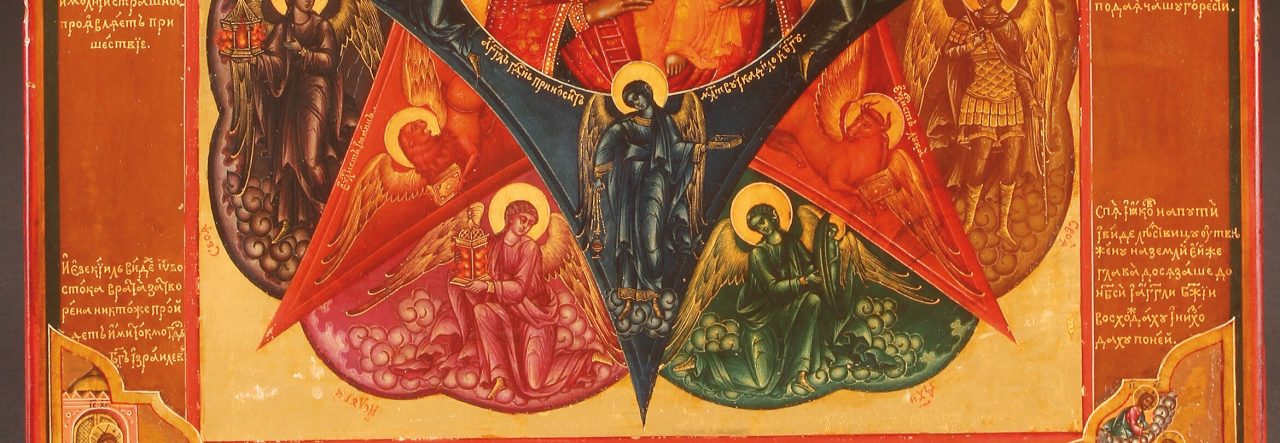
The Unburnt Thornbush (Neopalimaya Kupina) icon of Mary is of particular interest because it is so very “pagan” in its notion that a painted icon of divine figures has the power to protect from fire.  In old Russia, if a house or building burst into flame, people would stand holding this icon facing the fire in the belief that it would be extinguished.  It was also hung to protect dwellings from fire.

(Courtesy of Jacksonsauction.com)

There is much to say about this type.  Its origins are a mixture of references to Old Testament events, to symbolic references to Mary found in the Akathist hymn and canon, and a good portion of it comes simply from apocryphal writings such as the Book of Enoch, and the Book of Jubilees, particularly those portions relating to the angels surrounding the central figure of Mary holding the child Christ (Christ Emmanuel).

(Courtesy of jacksonsauction.com)

The immediate reference is to the Burning Bush seen by Moses in the biblical account — a bush that burned but somehow was not consumed.  In Eastern Orthodoxy this was and is seen as a prefiguration of Mary, who dogma teaches was pregnant with God (as Jesus) but was not harmed thereby.

That is why Mary holds the central position in this rose-shaped form that is like a Jungian mandala.  She is in the center with her child; about her are numbers of angels, who are the powers in nature that control such elements as lightning, thunder, and fire.  And beyond the rosette, in the four corners of the icon, are four scenes that show noted Old Testament prefigurations of Mary that are also mentioned in the Akathist, the noted hymn to Mary in Eastern Orthodoxy.

We will begin with those, which traditionally are:

Upper left:
Moses sees the Burning Bush (Exodus 3:2), shown here with Mary visible in a circle within the flames.  Mary was considered to have contained the fire of God, yet was not harmed (this explanation applies also to the separate Ognevidnaya icon depicting Mary with a fiery red face, popular in the 19th century, for which there is no origin story).

Upper right:
Isaiah’s lips are purified by the fire of a coal taken from the altar by a seraph. (Isaiah 6:5-7); Mary was considered purified by being pregnant with the “fire of God.” An alternate image illustrates Isaiah 11:1:

“And there shall come forth a rod out of the stem of Jesse, and a Branch shall grow out of his roots.” The inscription on that image on the second icon shown on this page reads “A shoot comes forth from the root of Jesse, and the blossom thereof is Christ.” The image depicts Jessie lying down, and on the tree that grows out of him, Christ is depicted.

Russian icon of Virgin Mary
Neopalimaya Kupina

Lower left:
The prophet Ezekiel sees a closed door in the East (Ezekiel 44:1-2), which symbolizes the virginity of Mary in E. Orthodoxy, the closed door to a temple containing the glory of God — the fire of divinity.

Lower right:
The Old Testament forefather Jacob sees, in a dream, a ladder from earth to heaven.  Mary is considered a ladder uniting earth and heaven in E. Orthodoxy, through her bearing of Jesus: “Rejoice, heavenly ladder on which God descended.”

Moving inward, we next come to the points of the eight-pointed “slava” (“Glory”) representing divine light and the Eighth day of Creation, the Day of Eternity.  In the upper left segment is an angel, representing the Evangelist Matthew as a winged man.  At upper right is an eagle, representing the Evangelist Mark.  At lower left is a lion, representing the Evangelist John, and at lower right is an ox, representing the Evangelist Luke.

The most interesting parts of the icon are the angels in the “petals” of the rose, which are usually eight or more in number.  They are the forces behind the elements of nature, the hidden powers that control the weather and relate also to the apocalyptic end of the world.  Inscriptions describing them vary from icon to icon.

Also usually found on this icon type is the inscription “Who makes his angels spirits, his ministers a flame of fire.”  “Who makes his angels spirits” is in some versions “Who makes his angels winds.”

There are a number of apocryphal sources responsible for this notion of angels controlling the weather and the elements, but one of the most obvious is the Book of Jubilees, Chapter 2:

  1. And the angel of the presence spake to Moses according to the word of the Lord, saying: Write the complete history of the creation, how in six days the Lord God finished all His works and all that He created, and kept Sabbath on the seventh day and hallowed it for all ages, and appointed it as a sign for all His works.
  2. For on the first day He created the heavens which are above and the earth and the waters and all the spirits which serve before him -the angels of the presence, and the angels of sanctification, and the angels [of the spirit of fire and the angels] of the spirit of the winds, and the angels of the spirit of the clouds, and of darkness, and of snow and of hail and of hoar frost, and the angels of the voices and of the thunder and of the lightning, and the angels of the spirits of cold and of heat, and of winter and of spring and of autumn and of summer and of all the spirits of his creatures which are in the heavens and on the earth, (He created) the abysses and the darkness, eventide , and the light, dawn and day, which He hath prepared in the knowledge of his heart.
  3. And thereupon we saw His works, and praised Him, and lauded before Him on account of all His works; for seven great works did He create on the first day.

One can see that the components of this icon have a great deal to do with fire and burning and lightning, as well as with frost, ice, rain and clouds.  When one combines these with the “fire” attributes of Mary, it is not difficult to understand how the belief arose that this icon could control the elements and subdue fire.

The central image of the star set upon the angelic rosette is that of Mary holding Christ Emmanuel.  She also holds a ladder, symbolizing her position as ladder between heaven and earth, the unifier of heaven and earth through the incarnation.  Also often seen is a stone on her breast, signifying the “Stone not cut by human hands” of Daniel 2:45:  “Forasmuch as you saw that the stone was cut out of the mountain without hands, and that it broke in pieces the iron, the brass, the clay, the silver and the gold.”  This signifies the virgin birth of Jesus from Mary, born without the participation of a human male.  Additionally one often sees a small image of Christ as “Great High Priest” upon Mary’s breast, showing him wearing a bishop’s crown.

It is common to have an image of God the Father (“Lord Sabaoth” — Gospod’ Savaof)) seen on clouds just above the main rosette.  He is usually shown with hands raised in blessing.

The icon of the Unburnt Thornbush, because of its supposed ability to protect from and to ward off fire, was very popular in Old Russia, where wooden buildings and dwellings were very common and fire a constant threat.  This icon type was particularly popular among the Old Believers.

*


THE OLD ATTITUDE TOWARD ICONS

Tikhvin icon of Virgin in Tikhvinsky Monastery
IThe “Tikhvin” (Tikhvinskaya) icon of Mary

There is an odd document floating about on the Internet titled The Icon FAQ, an article that attempts to influence potential or new converts, written by a fellow who is himself a Protestant convert to conservative Eastern Orthodoxy .  What interests me here is that in response to the question “Do [Eastern] Orthodox Christians pray to icons?” the rather obfuscating answer given by the Icon FAQ is, “[Eastern Orthodox] Christians pray in the presence of icons….”

As I often repeat, the best way to learn the truth about something is to examine not what someone says is the fact, but what really is the fact — in this case, what the actual practice of people was, what they — the “believers” — have actually done and said about the matter and still do and say.  It is unlikely you will ever hear the average non-convert Eastern Orthodox believer — past or present — talk about praying “in the presence of icons” — after all, one prays in the presence of shirts and shoes and building walls and a floor and ceiling in an Orthodox Church, but icons are in an entirely different category.

The fact is that when traditional Eastern Orthodox talk about prayer and icons, what they usually say is that they pray before (meaning in front of, facing) an icon, or that they pray to an icon.  That is the real state of the matter that the Icon FAQ ignores, because of course it has designs on the reader — it is religious propaganda.  But the issue raised by the question does takes us to a rather fascinating subject — the traditional attitude toward icons of Mary in Eastern Orthodoxy.

If an alien anthropologist were to visit Russia, he or she (or it?) would quickly form the opinion that the chief deity in Russian Orthodoxy (and the same applies to other E. Orthodox countries to a large extent) is a Mother Goddess who has given birth to a small male god.  That is because of the immense popularity of icons of Mary and the great number of different types, which greatly exceeds those devoted to Jesus, who no doubt would be seen as a secondary deity.

When we look at this great number of “wonder-working” Marian icons in particular, we find ourselves back in the mindset of the Greco-Roman world of worship that preceded the advent of Christianity; back in a pre-scientific world in which divine images speak, move about of their own volition, punish, reward, and even bleed.

In her book Le culte des icônes en Grèce (The Cult of Icons in Greece), Katerina Seraïdari writes of the Panayia (Panagia) Limnia, the “All Holy One of Limni,” an icon of Mary that supposedly came to the village of Limni in 1560.   It’s “appearance,” as they say in Russia, was not unusual in comparison to all other stories.  It came floating on the water, and it was placed in the Hermitage of St. Anne.  But the icon disappeared three times from that site, showing that it preferred another location.  Seraïdari writes, “Ces déplacements miraculeux révélèrent à la communauté la volonté de l’icône ainsi que son propre destin….” “These miraculous displacements revealed to the community the will of the icon as well as its proper destination….”  I have added the emphasis.  The icon was eventually moved to the site it preferred.

Now one may think, “Well, this is someone writing in the 21st century and attributing something to the icon — a will — that would not actually be the case in Eastern Orthodoxy.”  But really just the opposite is true.  This manner of speaking of the icon as though it had its own will and desires and movements is actually the way such icons have been traditionally regarded in Eastern Orthodoxy.  If an icon of Mary does not like where it is, it will go someplace else, and it will get there by floating on the water — as in the case of the Panagia Limnia — or it will fly through the air, as in the case of the Tikhvin (Tikhvinskaya) icon of Mary in Russia, etc. etc.

In short, the traditional attitude toward icons — the attitude actually held by Eastern Orthodox believers, not theoreticians or converts — was that icons behaved like living creatures — and so they were treated as such.  That is why a believer would pray before such an icon, as though talking to a person, and that is why it is often said that believers would pray to an icon, because that is precisely what they did.  One can see from this that the feeble notion that Eastern Orthodox believers merely pray “in the presence of” icons is, from an historical point of view, both very misleading and quite inaccurate.  To discover the real situation one must go to what was actually said and written about such icons and how they were regarded by the ordinary believers of past centuries.

The view of icons in Egyptian Coptic Christianity was very much the view held throughout the Eastern Orthodox realms:

“Generally speaking, the Copts make no distinction between the qualities and characteristics of the icon and those of the person represented by the icon.  Whatever the person could perform in his or her lifetime or post mortem, the icon representing the person could do as well.  For that matter, the icon is the artistic ‘incarnation’ of the person, and as such it is subject to as much veneration as the person represented.  Therefore, it is not surprising that the Copts, like the Greeks and the Russians, ascribe human qualities such as weeping, sweating, and bleeding to their icons.” (Two Thousand Years of Coptic Christianity, Otto F. A. Meinardus, American University in Cairo Press, 1999)

There is a great deal more that could be said on this subject, because there is a voluminous amount of legend and folklore dealing with “miraculous” Marian icons.  In fact just to discuss them one by one would be very revealing, but I shall have to save further comments for another posting.

*